I Tested 10 AI Dating Tools for First Message Ideas in 2026

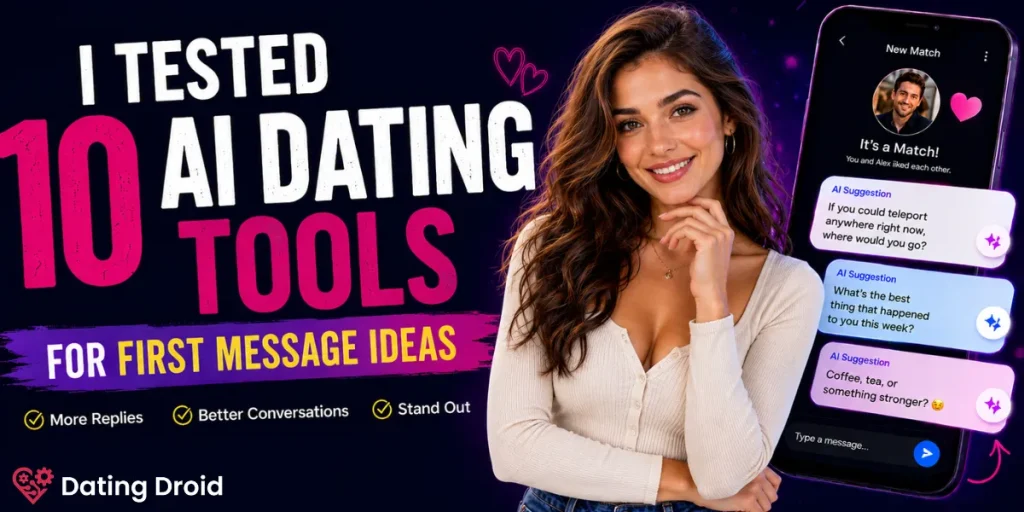
If you want AI dating tools for first message ideas, the best tools are not the ones that spit out the most lines. They are the ones that help you sound more like yourself, only sharper.
My short answer: AI is best for rewriting, tightening, and angle-switching, not for inventing your entire personality from scratch. The winning workflow is simple. Feed the tool one real detail from the profile, ask for three styles, then cut anything that sounds like a LinkedIn intern trying to flirt at gunpoint.
After testing 10 tools and workflows, my buyer take is this: prompt-based assistants are best for flexible opener ideas, companion-style tools are best for low-pressure rehearsal, and screenshot-heavy “instant reply” tools are where privacy risk climbs fastest. If you want more replies, steal structure, not scripts.
🌐 My Testing Method for AI Dating Openers
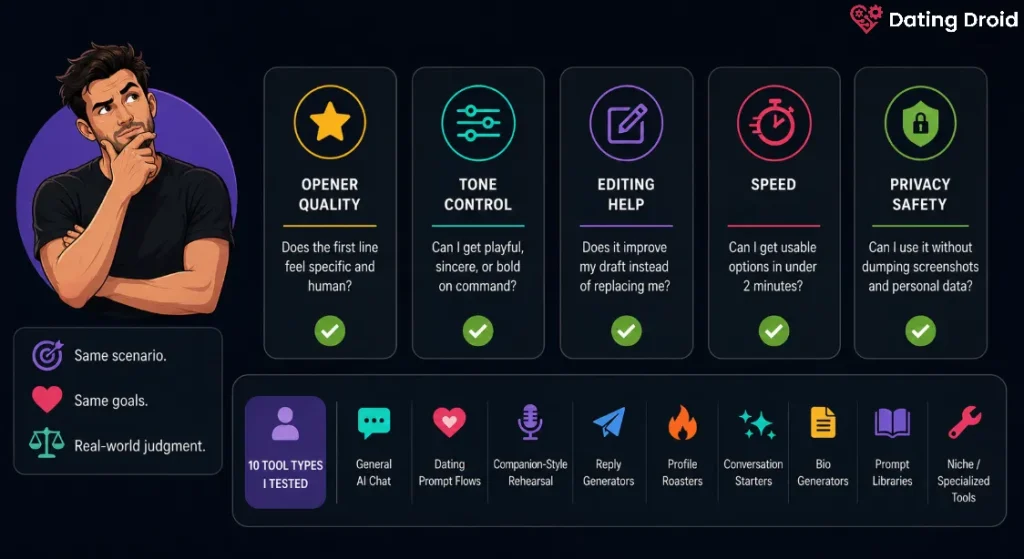
I did not test these tools like a starry-eyed guy who thinks one line will save his dating life. I tested them like a tired dating-app realist. I wanted to know which tools help you send a better first message, which ones make you sound fake, and which ones quietly invite privacy mistakes.
So I ran the same core scenario across ten tool types and products: profile-summary prompts, general AI chat, dating-focused prompt flows, companion-style rehearsal, and reply-generator style workflows. I used the same three opener goals every time: one playful line, one grounded line, and one slightly bold line that still felt like a real person would send it.
The scoring was based on five things: message originality, profile relevance, tone control, cringe risk, and privacy safety. If a tool needed a screenshot to work well, it lost points immediately unless there was a cleaner manual-text alternative.
| Test category | What I checked | What fails fast |
|---|---|---|
| Opener quality | Does the first line feel specific and human? | Generic compliments and fake charm |
| Tone control | Can I get playful, sincere, or bold on command? | Same voice for every prompt |
| Editing help | Does it improve my draft instead of replacing me? | Tool writes a whole fake persona |
| Speed | Can I get usable options in under 2 minutes? | Endless prompt fiddling |
| Privacy | Can I use it without dumping screenshots and personal data? | Screenshot-first workflow with no restraint |
✨ The Main Lesson: AI Works Better as a Wingman Than as a Puppeteer
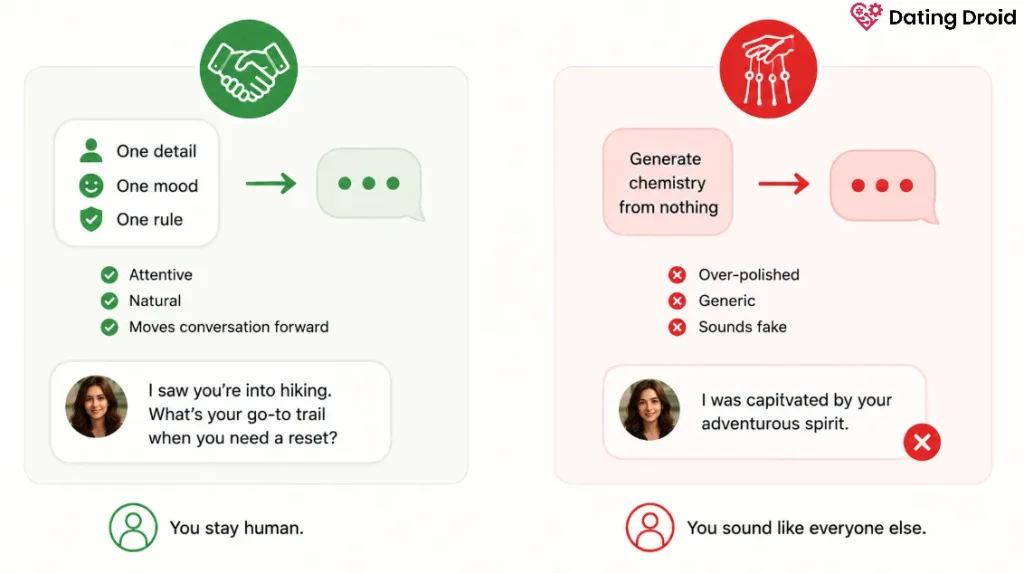
The best first messages are not “clever.” They are attentive. They grab one detail, react to it naturally, and move the conversation forward without sounding like you copied from the Department of Flirting.
That is exactly why AI can help and hurt at the same time. It helps when you already have an angle but want cleaner wording. It hurts when you ask it to generate chemistry from nothing. Then it fills the gap with over-polished nonsense like “I was captivated by your adventurous spirit.” Brother, no.
The sweet spot is narrow but powerful. You give AI a real input. One detail from the person's profile. One mood you want. One hard rule about what not to say. Then you let it produce options and choose the least embarrassing one.
That is how you stay human.
⚙ Best AI Tools for First Message Ideas
1. Prompt-based assistants: Best overall for flexible opener ideas
This was the most reliable lane. You take a profile detail, paste it into a general AI tool or structured prompt helper, and ask for three opener styles. The better systems let you say things like “playful but not corny” or “shorter, less try-hard, more specific.”
Why it worked: flexibility. I could steer the message instead of accepting whatever the tool thought “rizz” meant that day. This was the best setup for Hinge and Bumble because those platforms reward profile-specific openers more than generic charm blasts.
The catch is obvious. If you do not provide enough context, the output becomes mush. AI cannot rescue a lazy input and turn it into magnetic personality.
2. Companion-style tools: Best for rehearsal and confidence
This was the sneaky winner for anxious texters. Companion tools like Candy AI, GirlfriendGPT, and Kupid AI are not pure dating-app utilities, but they are surprisingly good for practicing tone. I could test whether a message felt dry, too intense, too long, or weirdly try-hard without involving a real match in the experiment.
That matters more than people admit. A lot of bad first messages are not bad because the idea is terrible. They are bad because the sender cannot hear how stiff they sound. Companion tools give you a mirror. Not a final answer. A mirror.
The limitation is that these tools are not optimized for real-profile context out of the box. They are better for style rehearsal than for exact opener generation.
3. Screenshot-reply workflows: Fast, but risky
Yes, these can feel magical. Upload a profile or chat screenshot. Get instant suggestions. Move on with your life.
They are also the easiest way to get careless. Screenshot workflows create more privacy exposure than manual text prompts because they often include photos, usernames, location hints, app interface details, and other information that does not need to leave your device. So while this category can be useful, I only trust it if I manually type the relevant text instead.
Fast is nice. Oversharing is not.
👀 What Each Tool Type Was Actually Best At
| Tool type | Best use | Biggest weakness | Best platform fit |
|---|---|---|---|
| Prompt-based AI assistant | Generating 3-5 opener angles from one profile detail | Needs decent input to avoid generic output | Hinge, Bumble |
| Companion-style chatbot | Rehearsing tone and trimming awkwardness | Less profile-specific by default | Hinge, Tinder |
| Dating-focused opener generator | Fast templates for low-effort users | Often repetitive and too polished | Tinder |
| Screenshot-reply workflow | Speed and convenience | Highest privacy risk | Any app, but use cautiously |
| Manual rewrite with AI editor | Tightening your own line | Useless if your original idea is flat | All apps |
🔥 Real Test Examples: Bad AI Output vs Better AI Output
This is where the difference showed up hardest.
Profile detail:
Loves bad horror movies and makes excellent guacamole.👎 Bad AI opener:
I must say, your profile really stood out to me. A fellow horror movie enthusiast with culinary talent is a rare combination.That is not a message. That is an HR memo with flirt crumbs.
👍 Better AI opener:
You had me at bad horror movies. Important question: is your guac elite enough to survive a first-date taste test?Why it wins: it sounds like a person. It uses one detail. It opens the door for a playful reply.
Another profile detail:
Runs half-marathons but also loves lazy Sundays.👎 Bad AI opener:
I admire your balance between ambition and relaxation.Please never send that to anyone unless you want to be professionally ignored.
👍 Better AI opener:
So are you the kind of half-marathon person who inspires lazy people, or the kind who makes the rest of us feel guilty before brunch?That line is playful, low-pressure, and specific. That is the whole game.
✒ The Best Prompt Formula I Found
After testing a bunch of prompt shapes, this one produced the most usable first-message ideas:
Write 3 first-message ideas for a dating app based on this profile detail: [paste detail]. Make one playful, one warm, and one bold. Keep each under 22 words. No cheesy compliments. No pet names. No poetry. Make them sound like a real person.That prompt works because it gives the tool a lane, a tone range, and a few hard walls. The hard walls matter. Without them, AI drifts toward smooth nonsense or fake confidence.
If I already had a draft, I used a repair prompt instead:
Rewrite this opener to sound more natural and less try-hard. Keep the core idea. Shorter. More specific. No cringe.That second prompt honestly beats the first one once you get decent at idea generation, because editing your voice is almost always better than outsourcing it.
🤝 Which Tools Helped by App
Hinge
Hinge rewards specificity. The best tools here were prompt-based assistants and manual rewrites because they let me react to one exact prompt answer or photo caption without drifting into generic flirt fog.
Bumble
Bumble worked best when the AI helped me stay concise. Good openers here felt light, quick, and observant. Too much flourish made the message look more artificial than confident.
Tinder
Tinder was the one place where faster template-style tools did not instantly fall apart. The app context is a little more tolerant of punchier, simpler openers. Even then, the winners still used one detail instead of one-size-fits-all charm sludge.
| App | Best workflow | What to avoid |
|---|---|---|
| Hinge | Profile-specific prompt plus manual trim | Generic compliments with no callback |
| Bumble | Short playful opener with one hook | Overexplaining and fake confidence |
| Tinder | Fast punchy line plus light question | Hyper-scripted “elite rizz” language |
🔏 Safety and Privacy Notes You Cannot Skip
This is the part where DatingDroid gets less glamorous and more useful.
Hinge's current safety guidance warns that bad actors often try to move conversations off the app too fast. The FTC's romance-scam guidance says the same basic thing in plainer language: scammers push urgency, emotional escalation, and off-platform contact because it gives them control. That matters here because bad AI habits can accidentally mimic scammer behavior.
If your AI-generated opener sounds too intense, too polished, or too ready to move off-app, it can backfire for both attraction and trust. So the privacy rule is not just “protect your data.” It is also “do not use AI in ways that make you look like a fake person.”
My safety rules are simple:
AI can sharpen your message, but bad prompts can make you look fake, pushy, or unsafe. DatingDroid’s privacy guide shows you what not to share, what to remove, and how to use AI without killing trust.
💔 When AI Hurts Your Chances
AI hurts when it makes you sound less human than you already were.
The biggest loser patterns in my test were: overuse of compliments, weirdly formal language, fake confidence, and what I call “movie trailer flirting.” Lines like “I sensed an irresistible energy from your profile” technically use words, but they do not create attraction. They create distance.
The second way AI hurts is subtler. It can make every conversation feel optimized instead of alive. If every opener is carefully generated, A/B tested, and polished into smoothness, you stop reacting to the actual person. You start managing a campaign.
Nobody wants to date a campaign.
✨ FAQs
What are the best AI dating tools for first message ideas?
The best tool is usually a flexible prompt-based assistant that rewrites using one real profile detail. Companion-style tools are better for rehearsal than exact opener generation.
Are AI-generated first messages worth using on dating apps?
Yes, if you use AI for angles and edits instead of copying full scripts. The goal is to sound more like yourself, not less.
Should I upload dating profile screenshots to AI tools?
Only if you absolutely have to, and even then I would avoid it. Manual text prompts are safer because they expose less personal data from the other person's profile and from your own app use.
Which app benefits most from AI opener help?
Hinge benefits the most because profile-specific openers matter there. Bumble is a close second. Tinder is a little more forgiving, but generic lines still lose.
Why do AI dating openers sound so fake sometimes?
Because the prompts are vague and the tool fills the gap with polished filler. Better prompts and harder constraints produce better messages.
Can companion tools help with real dating conversations?
Yes. They are useful for tone rehearsal, confidence testing, and trimming awkward wording. They are less useful as direct copy-and-paste opener machines.
External Sources
🎯 Final Verdict
AI absolutely can help with first message ideas. It just works best when you treat it like a wingman, not a ventriloquist.
The winning move is to pull one real detail from the profile, ask for three styles, and then choose the option that still sounds like somebody you would actually let represent you in public. If you want a safe rehearsal lane, test tone inside Candy AI, GirlfriendGPT, or companion-style alternatives before you send anything live. Then trim hard, keep it specific, and stay on-platform until trust is earned.
That is the whole formula. Specific beats slick. Human beats optimized. And one good opener beats twenty AI-generated personality crimes.

Stay Updated with Us