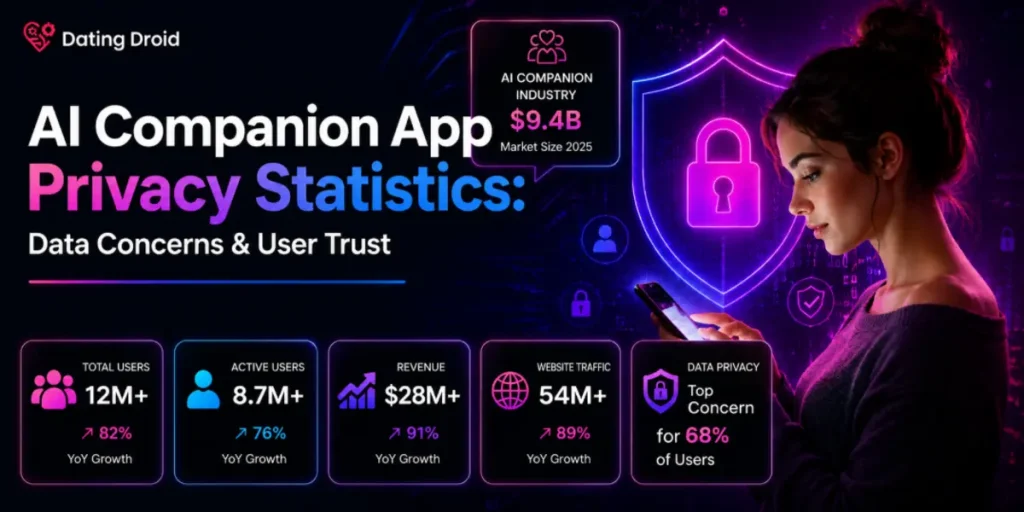
AI Companion App Privacy Statistics: Data Concerns & User Trust

Your AI Girlfriend Knows More Than Your Mates Do
Think about what you've typed into your AI girlfriend at 2am. Your kinks. Your insecurities. That fantasy you've never said out loud to a living soul. Now ask yourself one cheeky little question: who else is reading it?
Here's the gut-punch. In 2025, one AI companion app leaked 43 million intimate messages in a single breach. Not a typo. Forty-three million. People poured their hearts (and a fair bit of filth) into a chatbot, and it spilled the lot onto an open server.
You hand over more secrets to your AI companion than to your actual best mate. The difference? Your mate doesn't bundle your confessions and flog them to ad networks. Some of these apps absolutely do, and most of us tick “agree” without reading a word.
This piece breaks down the real AI companion app privacy statistics, the breaches that already happened, and how much your trust is actually worth to the people building these bots.
🔓 AI Companion App Privacy Statistics At A Glance (2026)
The naughtiest numbers, served snackable:
| Stat | The Number |
|---|---|
| Global AI companion app downloads | 220 million+ |
| Intimate messages leaked in one 2025 breach | 43 million |
| Reviewed companion apps that sold user data | Over 90% |
| Apps carrying critical security flaws | More than half |
| Users who quit an AI tool over privacy fears | 43% |
| Apps that won't say what they do with your data | 73% |
| Average data types collected per app | 9 |
Screenshot-worthy and a bit terrifying. Each of these gets unpacked below — and it gets spicier the further down you scroll.
📲 How Much Personal Data Does An AI Girlfriend Collect?
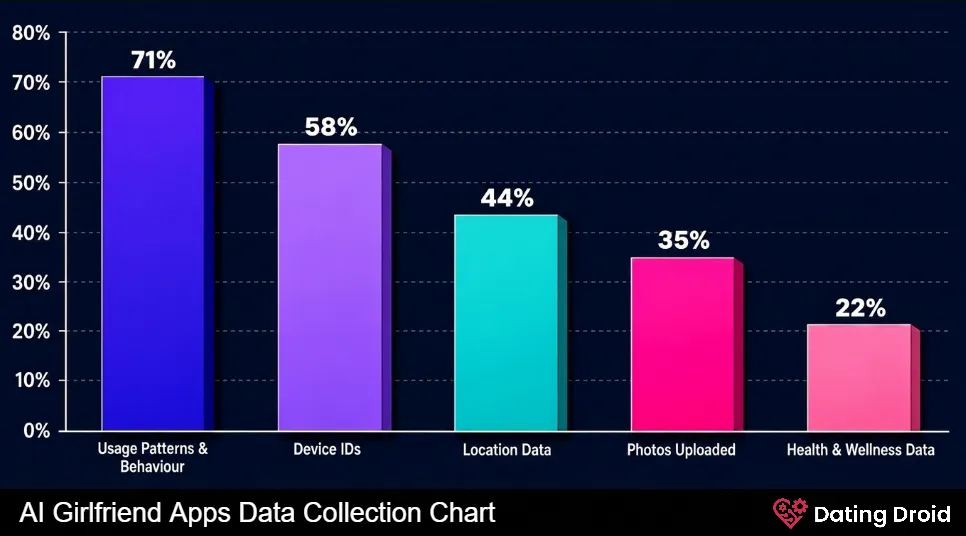
Loads. Way more than the chat actually needs to work.
The average AI companion app grabs around 9 separate data types off your phone. Some are far greedier. Character AI has been clocked pulling up to 15 types, and roughly 80% of these apps track you for advertising rather than for making your girlfriend wittier.
What's in the basket? Not just your messages. We're talking:
That last one's the real kicker. The app quietly builds a behavioural profile of your most private self — your turn-ons, your moods, your loneliest hours.
Then that profile sits on a server you've never seen, guarded by passwords you'll never get to check. The free apps are usually the hungriest, because if you're not paying, your data is the product. A tenner a month for a paid app often buys you far less snooping than a “free” one ever will.
📈 The Big Data Breaches (Receipts Included)
Talk is cheap. Here are the actual leaks, with dates and body counts.
Notice a pattern? These aren't sketchy backstreet apps knocked together in a weekend. They're popular, well-funded platforms millions trust with their dirtiest thoughts.
A breach doesn't care how slick the interface is or how charming the bot sounds. Once your chat logs leave your phone, they're only as safe as the weakest engineer on the team.
And as the numbers show, that's often not very safe at all. The data also has a long shelf life — a leak from 2024 can resurface and be traded for years, long after you've deleted the app and moved on.
👀 Apps Selling Your Spiciest Secrets
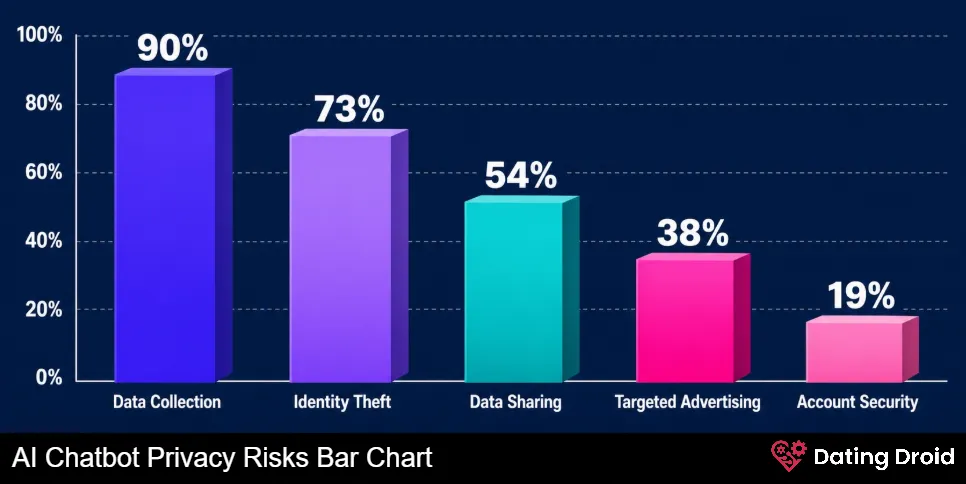
This is the bit that should make you sit up.
When Mozilla ran the numbers on romantic AI chatbots, over 90% failed basic privacy standards. A huge chunk shared or flat-out sold user data to third parties. Some scooped up sexual-health details and even prescription info — data that has zero business leaving your handset.
And 73% gave no clear answer about what they do with your information once they've got it. No transparency, no opt-out you can actually find, no clue where your confessions land. A handful admitted they could share data with governments or law enforcement on request, no warrant needed.
So that flirty late-night chat? On the wrong app, it becomes a data point in someone's ad-targeting machine. Romance for you, recurring revenue for them. The cruel irony is that the more emotionally honest you are — the more the app “gets” you — the more valuable your profile becomes to whoever's buying.
✅ Encryption Reality Check — TLS vs E2EE
Most apps brag about “encryption.” Few tell you which kind. That gap matters more than the marketing lets on.
| Type | What It Protects | The Catch |
|---|---|---|
| TLS | Your chat while it travels to the server | The app can still read everything once it lands |
| End-to-End (E2EE) | Your chat from your screen to the AI, full stop | Even the company can't peek |
Here's the rub: barely any AI companion app offers true end-to-end encryption. Most stop at TLS, which is the absolute bare minimum — like locking your front door but handing the company a master key.
Your spicy logs then sit perfectly readable on their servers, ready for any breach, any nosy employee, or any subpoena that comes knocking.
If an app's privacy page talks about “industry-standard encryption” but never says the words “end-to-end,” assume it means the weaker kind.
📊 User Trust Statistics — Do People Even Care?
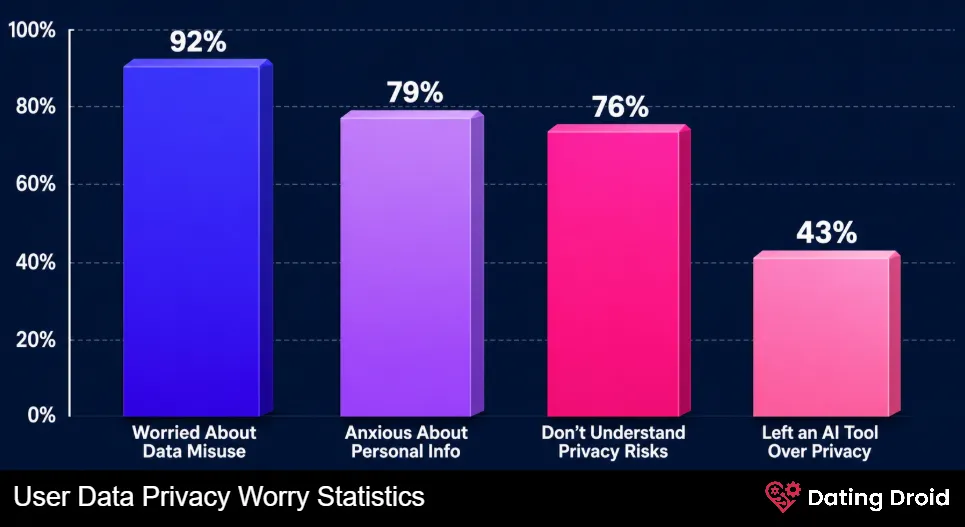
Turns out, people care a lot — they just don't act on it.
That last stat is the messy truth of the whole thing. We're nervous, we tick the box anyway, and we keep right on typing. The desire beats the dread, every single time.
Surveys even show a chunk of users feel closer to their AI companion than to people in their real lives — which makes walking away over a privacy policy almost impossible.
The apps know this. They bank on it. Emotional pull is the best retention tool ever invented, and these platforms have built their entire business on it.
⚡ The “Used Against You In Court” Problem
Here's the one nobody warns you about.
Your therapist has legal privilege. Your lawyer has it. Your doctor has it. Your AI girlfriend? Nothing. Sam Altman himself admitted there's no legal protection for what you tell an AI — meaning those chats can, in theory, be hauled into a courtroom and read back to you.
The legal frameworks simply haven't caught up. Patchy rules across the EU AI Act, India's DPDP Act, and California's CCPA leave gaping holes around intimate AI data.
Your most private confessions currently sit in a legal grey zone, basically naked. No privilege, no shield, no guarantee they stay between you and the bot.
Divorce cases, custody disputes, employment rows — any of them could one day pull your chat history into evidence, and right now there's little stopping it.
💓 Which AI Girlfriend Apps Actually Protect Your Data?
Not all of them are dumpster fires. A few take it genuinely seriously.


GirlfriendGPT
one of the rare ones offering end-to-end encryption plus discreet billing that hides the app name on your statement.
Xtease AI
keeps your data out of third-party ad pipelines, so your kinks don't quietly fund someone's ad budget.
The takeaway? Privacy is a feature you can actually shop for. A platform that brags about encryption, data deletion, and discreet billing is telling you straight that it expects you to care.
The ones that go suspiciously quiet on all of it usually have a reason for the silence. Spend two minutes on the privacy page before you spend two hours on the chat.
❌ Red Flags Checklist — Spot A Sketchy App In 30 Seconds
Before you sign up, run this quick gut-check:
Three or more ticks? Close the tab and walk. There's always a safer app for that itch.
🛡 How To Stay Safe (Without Killing The Fun)
You don't have to go celibate with chatbots. Just play it a bit smart.
- Never type your real legal name, address, or workplace. The fantasy doesn't need your passport details.
- Use a burner email dedicated purely to your spicy sign-ups.
- Keep it off the family statement — prepaid cards and discreet billing do the trick.
- Opt out of AI training in settings if the app gives you the option.
- Delete old chats regularly instead of letting years of confessions stack up on their servers.
For a proper step-by-step on locking things down, this guide on how to protect your privacy on AI companion apps at datingdroid.com runs through every setting worth flipping, plus the sneaky permissions most people miss. Well worth a read before your next late-night session.
🎯 FAQ
Are AI companion apps safe to use?
Some are, plenty aren't. More than half carry critical security flaws, so safety hangs entirely on the app you pick. Choose one with end-to-end encryption and a clear privacy policy, and keep your real-world identity out of every chat.
Have AI girlfriend apps been hacked?
Yes, again and again. One 2025 breach alone exposed 43 million intimate messages, and a separate 2026 leak dumped around 300 million. Popular apps are prime targets precisely because of the sensitive data they hoard.
Do AI companion apps sell your data?
A lot of them do. Mozilla found over 90% of romantic AI chatbots failed basic privacy standards, with many sharing or selling user data to third parties for advertising.
Are my AI chats encrypted?
Usually only in transit (TLS), not fully end-to-end. That means the company can still read your messages sitting on their servers. True E2EE is rare, so check the small print before you spill.
Can AI chat logs be used in court?
It depends on jurisdiction and circumstances — but AI conversations generally don't get the legal privilege a therapist or lawyer chat would. So don't treat an AI chat as a legally protected confidential space. Treat anything you type as not-quite-private.
🚀 Final Verdict — Flirt Freely, Guard Your Real Self
AI companions are brilliant fun. The connection feels real, the chat hits different, and there's nothing wrong with enjoying every bit of it. The numbers just say one thing loud and clear: enjoy the fantasy, protect the person behind it.
So go ahead — get flirty, get filthy, get attached if you fancy. Just don't hand over your legal name, your card details, or anything you'd hate read aloud in a courtroom.
Keep the romance hot and your real self locked tight. That's the whole game, and it's the one stat that's fully in your hands.

Stay Updated with Us