AI Boyfriend App Statistics 2026: Trends & 2027 Outlook

You only meant to see what an AI boyfriend was like. Then he had a decent smile, a slightly cheeky opening line and enough charm to make another message tempting.
That little flicker of curiosity has plenty of company. “AI boyfriend” gets an estimated 22,200 monthly Google searches in the United States, with another 5,400 in India and 2,900 in the UK. People are looking for a virtual boyfriend, a flirty conversation or a fictional romance they can shape themselves.
The interesting part of AI boyfriend app statistics is what sits behind that first search. Some people want free chat before committing.
Others want a voice, a custom character or a longer story with someone who remembers where they left off. A pretty face gets your attention, but a little personality makes you linger.
Those searches measure interest, rather than relationships. One person can look for several apps before choosing one, and curiosity doesn’t always turn into a subscription. The conversation still has to win you over.
AI boyfriend app statistics at a glance
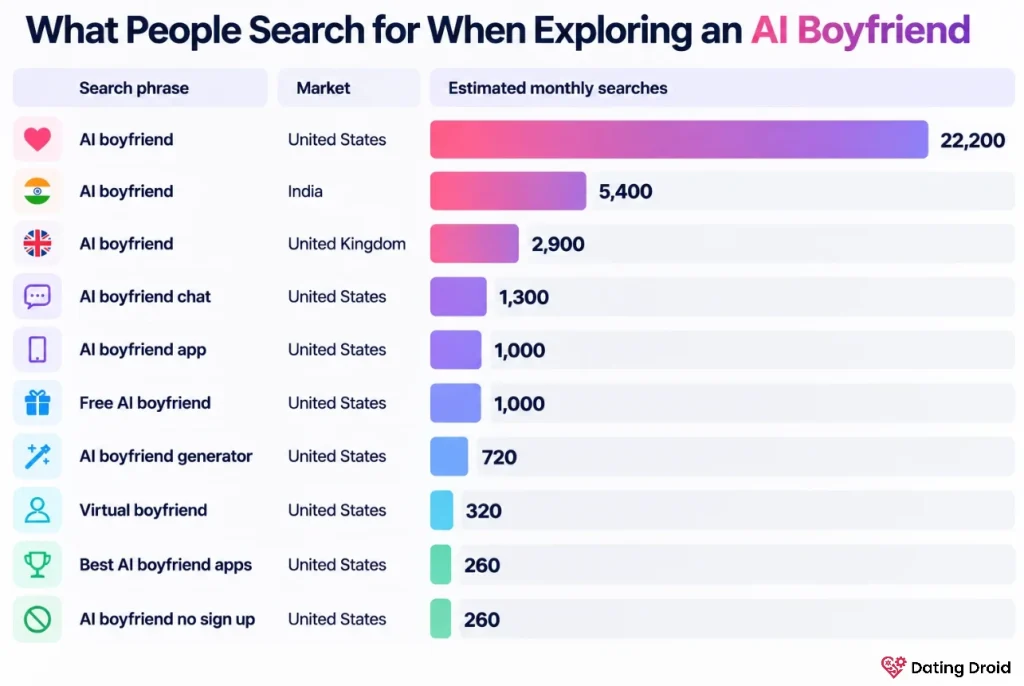
Average monthly Google search estimates for English-language queries, retrieved 10 September 2026; these are averages, not September-only search counts.
| Search phrase | Market | Estimated monthly searches |
|---|---|---|
| AI boyfriend | United States | 22,200 |
| AI boyfriend | India | 5,400 |
| AI boyfriend | United Kingdom | 2,900 |
| AI boyfriend chat | United States | 1,300 |
| AI boyfriend app | United States | 1,000 |
| Free AI boyfriend | United States | 1,000 |
| AI boyfriend generator | United States | 720 |
| Virtual boyfriend | United States | 320 |
| Best AI boyfriend apps | United States | 260 |
| AI boyfriend no sign up | United States | 260 |
The broad phrase attracts the most attention, but the smaller searches suggest more specific wishes. “Chat” puts the conversation first. “Generator” suggests an interest in creating something.
“Free” brings the budget into the room before the flirting has even started.
That’s a useful place to begin your own search. You can fancy the idea of an AI boyfriend without wanting every feature bundled around him.
Knowing what appeals to you makes it easier to ignore the extras that don’t.
Where people are searching for an AI boyfriend?
The US leads the six markets below for the main phrase, followed by India and the UK.
There’s also measurable English-language interest in Canada, Australia and Singapore.
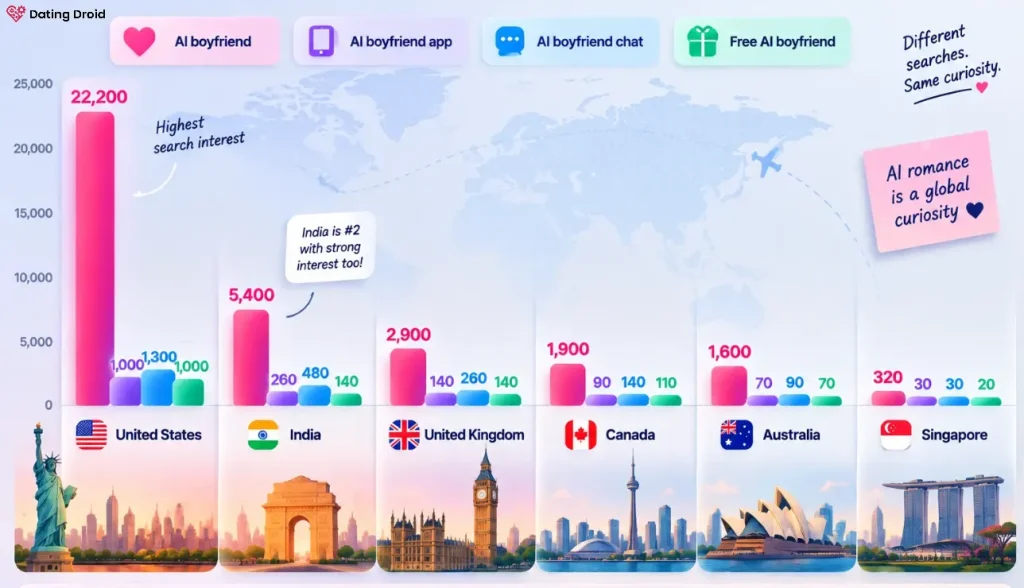
| Country | AI boyfriend | AI boyfriend app | AI boyfriend chat | Free AI boyfriend |
|---|---|---|---|---|
| United States | 22,200 | 1,000 | 1,300 | 1,000 |
| India | 5,400 | 260 | 480 | 140 |
| United Kingdom | 2,900 | 140 | 260 | 140 |
| Canada | 1,900 | 90 | 140 | 110 |
| Australia | 1,600 | 70 | 90 | 70 |
| Singapore | 320 | 30 | 30 | 20 |
The main “AI boyfriend” phrase adds up to 34,320 estimated monthly searches across these six countries. That’s a total for this country selection, not a worldwide audience count.
It leaves out other countries, other languages and people who find characters inside an app without Googling them.
India takes second place for both the main phrase and “AI boyfriend chat” in this comparison. If you have only seen digital romance discussed as an American trend, those numbers give you a wider picture. There’s plenty of English-language curiosity elsewhere, too.
The experience still needs to fit where you live. A price that looks manageable in US dollars may feel different after currency conversion. A voice you enjoy in a short demo may be less comfortable if it struggles with your accent or the names you use.
If you switch between English and another language, try that naturally during a free conversation. A boyfriend character can have a lovely face and still lose the mood when you have to keep translating yourself.
AI boyfriend chat gets more specific than simple curiosity
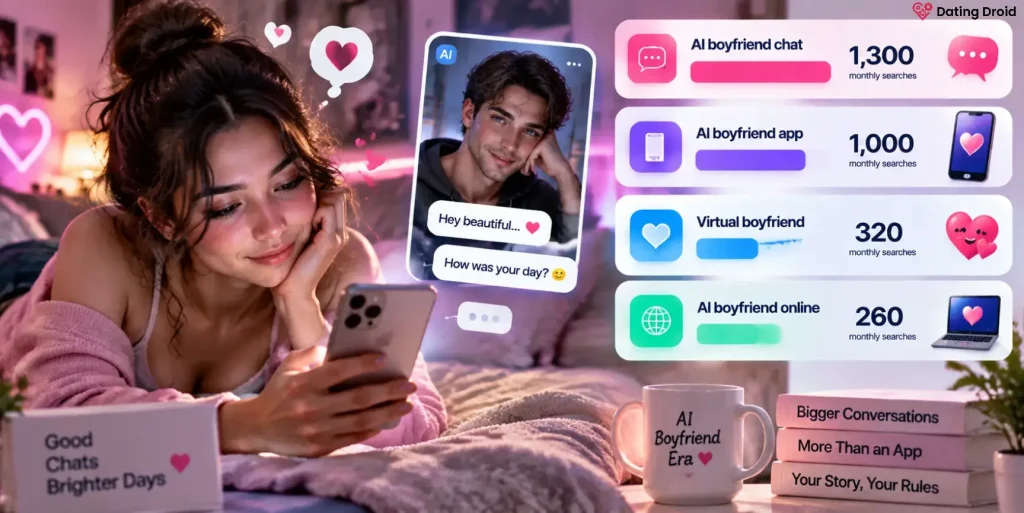
In the US, “AI boyfriend chat” attracts an estimated 1,300 monthly searches, compared with 1,000 for “AI boyfriend app”. “Virtual boyfriend” adds another distinct phrase at 320, while “AI boyfriend online” sits at 260.
Those searches point towards slightly different starting points. You might be looking for an app to keep on your phone.
You might want a browser chat that you can try immediately. Or you might still be working out what a virtual boyfriend actually does.
An AI boyfriend is a fictional male companion generated by software. You chat with the character rather than being matched with a real person.
Depending on the service, a boyfriend chatbot can offer romantic conversation, character customisation, voice features or a continuing storyline.
That makes it a different choice from ordinary online dating. You’re not checking whether a stranger lives nearby or wants the same kind of relationship. You’re deciding whether an interactive character is enjoyable company.
The distinction matters most when an app feels convincing. A thoughtful reply can make you smile, but it doesn’t mean there’s a human partner reading your message.
You can enjoy the fantasy while staying clear about what is on the other side of the screen.
Interest in AI boyfriends is steady, with changes in what people want
The monthly US estimate for “AI boyfriend” was 22,200 in both January and July 2026. May reached 27,100, before June and July returned to 22,200.
The broad phrase shows continuing attention, rather than a rise every single month.
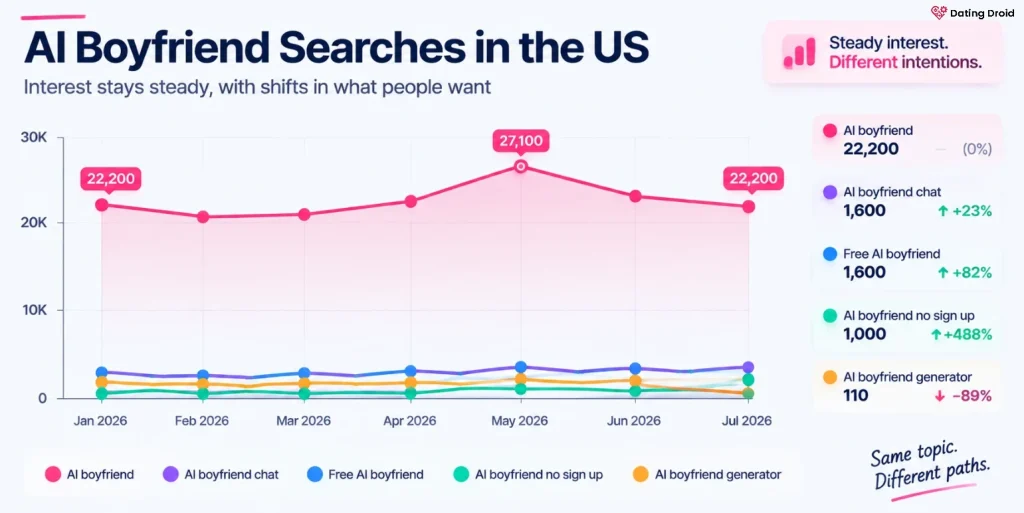
Some more specific searches moved differently:
| US search phrase | January 2026 | April 2026 | July 2026 | January–July change, rounded |
|---|---|---|---|---|
| AI boyfriend | 22,200 | 22,200 | 22,200 | 0% |
| AI boyfriend chat | 1,300 | 1,300 | 1,600 | +23% |
| Free AI boyfriend | 880 | 1,000 | 1,600 | +82% |
| AI boyfriend no sign up | 170 | 170 | 1,000 | +488% |
| AI boyfriend generator | 1,000 | 480 | 110 | −89% |
These are estimates for the named months; the earlier tables use average monthly estimates. The difference explains why a phrase can have a 1,000 average and a higher July figure.
The clearest change here is the stronger July interest in free access and chatting without registration.
The no-sign-up phrase rose sharply from a small starting point: 170 estimated searches became 1,000. That is a change in one search phrase, rather than a 488% jump in the number of people using AI boyfriends.
The pattern suggests a desire for an easier first try. It doesn’t tell us why someone searched, but it fits a very understandable wish: let the conversation make an impression before asking for an account or a payment.
Free chat also held at 1,600 in June and July, so its higher July figure was not isolated to a single month.
The generator phrase moved the other way over these dates. Creating an AI boyfriend and talking to one are related interests, but they are not interchangeable. An image-making trend can fade while people continue looking for conversation.
For you, the useful lesson is to look past a fashionable label. A product built around making an attractive picture may offer a very different evening from one built around an ongoing romantic chat.
Free AI boyfriend searches put the first conversation under pressure
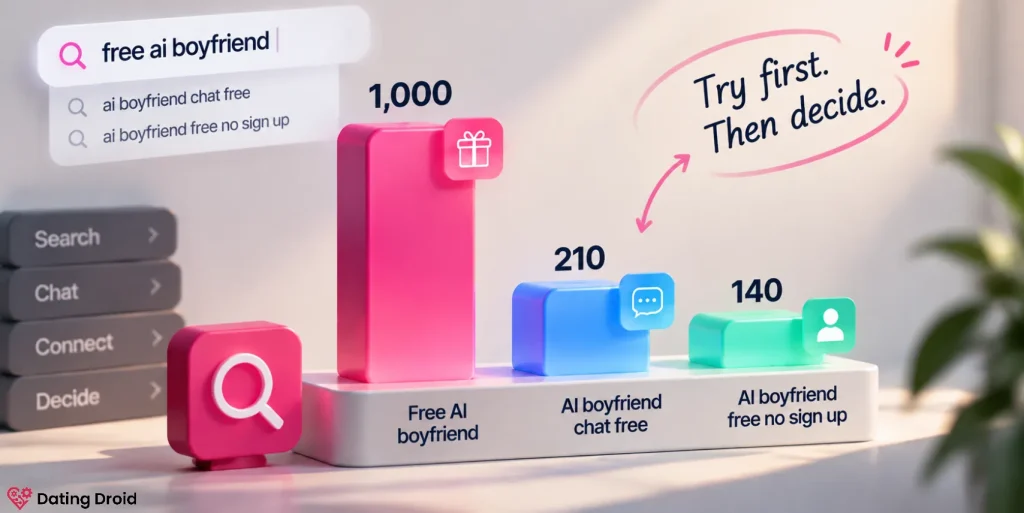
“Free AI boyfriend” attracts an estimated 1,000 monthly US searches. The more specific “AI boyfriend chat free” returns 210, while “AI boyfriend free no sign up” returns 140.
There’s nothing unromantic about wanting to try the conversation before paying. You’d probably want more than a flattering profile photo from a human date, too.
A useful free experience gives you enough room to notice the character’s style. Does he answer what you said? Can he keep a joke going? Does he ask something relevant, or keep circling back to the same compliment?
One warm reply won’t tell you much. A few changes of subject are more revealing. Mention a fictional dinner plan, disagree about a film and ask an ordinary question. You’ll get a better sense of the chat than you’d by feeding it nothing but romantic prompts.
“Free to start” can still leave some features behind a subscription. For example, you can create a Nomi AI boyfriend and begin chatting without a credit card, while voice calls and unlimited messaging require a subscription.
That can be a perfectly reasonable arrangement if the free allowance lets you judge what you’re buying. The awkward part is paying before you know whether the conversation suits you.
Keep that first trial simple. You don’t need to create an elaborate shared history or buy every extra to decide whether you want another chat.
No-sign-up chat appeals to people who want an easy start
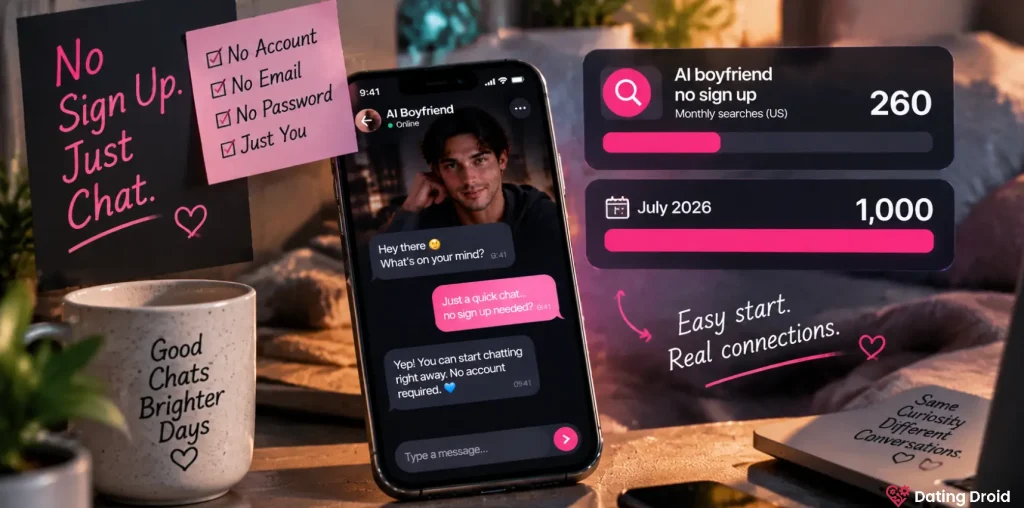
The US average for “AI boyfriend no sign up” is 260 monthly searches, with the individual July 2026 estimate reaching 1,000. It’s a small phrase compared with “AI boyfriend”, but it expresses a clear preference about getting started.
Sometimes you want to try a chat without another password, another welcome email or another account sitting unused on your phone. That’s especially understandable when you’re still deciding whether the whole idea is for you.
Easy access and privacy are separate questions, though. A chat that doesn’t ask for registration may still process messages and technical information.
Skipping an email field doesn’t automatically make the conversation anonymous.
It can also affect continuity. Before getting attached to a particular character, check whether the conversation survives closing the browser or changing devices.
You may prefer a quick anonymous-style session, or you may want an account that lets you return to the same story.
Choose the arrangement that fits your intention. A light flirt over lunch and a continuing fictional relationship don’t need exactly the same setup.
Custom AI boyfriends bring looks and personality into the same search
“AI boyfriend generator” gets an estimated 720 monthly US searches, while “AI boyfriend simulator” gets 70 and “anime AI boyfriend” gets 40.
A generator might help you create an image, build a character or do both. A simulator may lean more towards a game or a structured relationship experience. The words can sound similar while leading to very different products.
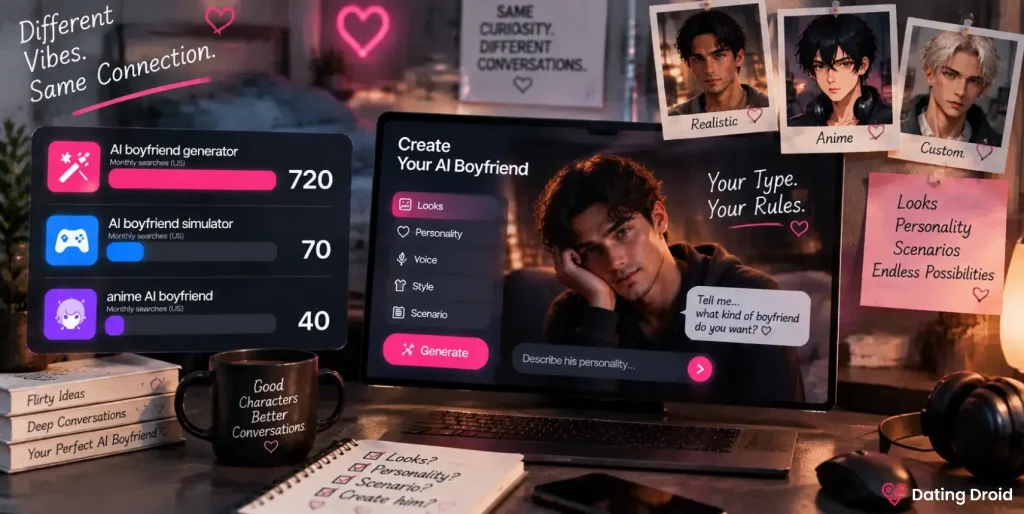
If you want a custom AI boyfriend to chat with, look beyond the appearance controls. Choosing his hair is the easy part. The more interesting question is how much say you have over your male AI companion’s humour, conversational pace and personality.
You might want someone gently teasing who lets the attraction build. Someone else may prefer an openly affectionate character from the first message.
With AI boyfriend roleplay, you can also set up a fictional meeting and let the conversation grow from there. A late arrival at a dinner party gives you something to talk about before anyone starts declaring undying love.
Give the character a few clear qualities rather than a page of contradictions. “Warm, curious and a little cheeky” gives you something recognisable to start with. You can adjust from there when you notice what makes the exchange enjoyable.
The artwork may be part of the appeal, but conversation still carries the relationship. A beautiful character who turns every reply into a speech can become tiring surprisingly quickly.
Keep romantic characters clearly adult, and build someone fictional. You can borrow the mood of a favourite romance without uploading a real person’s private messages or trying to recreate your ex.
Voice and memory can matter more than a large character gallery
An attractive profile might get you to open the chat. Continuity gives you a reason to return. If yesterday’s playful dinner conversation has vanished, the next exchange can feel like another first date you did not ask for.
Memory features are intended to help carry details across conversations, but they should not be treated as perfect recall.
Start with harmless preferences and see whether the character uses them naturally. Being able to correct a mistaken detail matters as much as having it remembered in the first place.
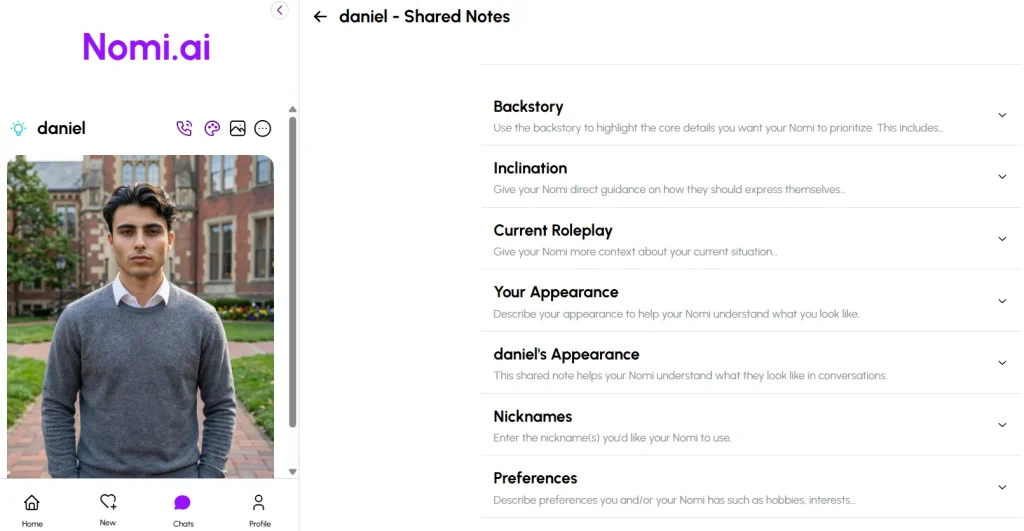
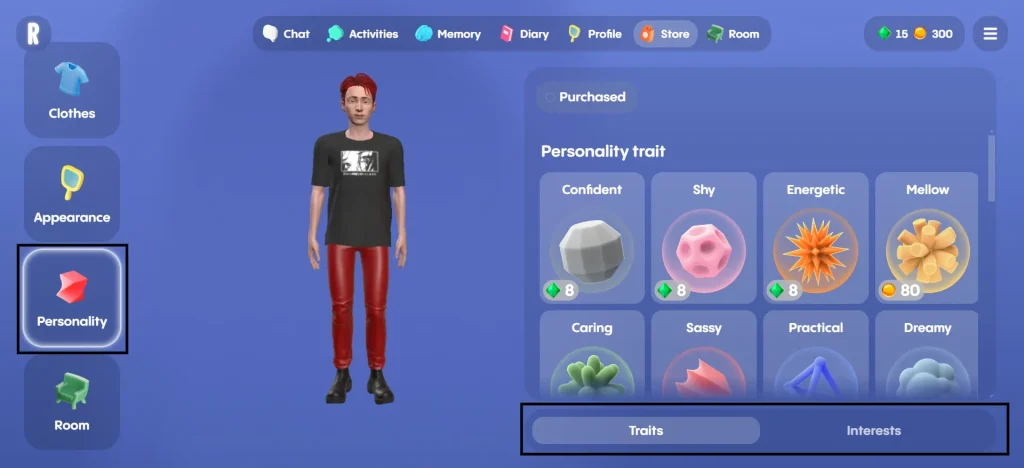
Nomi combines character backstories and memory features with voice messages and hands-free calls.
Replika also offers calls and avatar customisation. These are different ways to make a chat feel more personal, rather than proof that every conversation will suit your taste.
Voice changes what you notice. Pauses, pronunciation and the rhythm of a reply become part of the experience. A text you find charming might sound overly dramatic when spoken aloud.
If an AI boyfriend voice chat is important to you, hear enough ordinary conversation to judge it. A breathy greeting is a moment; listening comfortably for the rest of the chat is what you’re paying for.
Candy AI, Replika and Nomi attract boyfriend-specific searches
People also look for a boyfriend experience inside a named companion app. These searches bring the broad idea of digital romance a little closer to an actual choice.
| Boyfriend-specific search | Average monthly US searches |
|---|---|
| Replika AI boyfriend | 260 |
| Candy AI boyfriend | 140 |
| Nomi AI boyfriend | 110 |
| Character AI boyfriend | 40 |
“Candy AI male” adds a separate estimate of 30 monthly searches, while “Candy AI boyfriend review” returns 10. Those are related searches, so adding them together would not give us a count of different people.
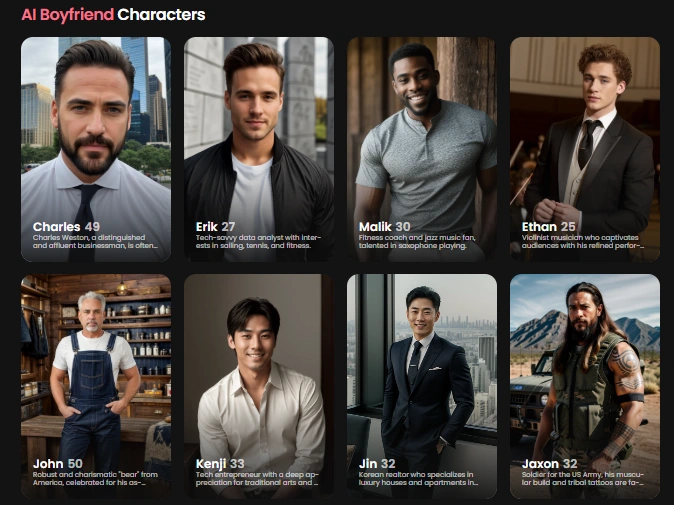
Those figures describe the exact phrases, not the brands’ full popularity. Someone who already knows an app may search its name alone or open it directly. A smaller boyfriend-specific estimate doesn’t mean fewer people enjoy male characters there.
What the phrases show is that the boyfriend category crosses product boundaries. You don’t always need an app with “boyfriend” in its name to find the experience.
A broader companion service may let you create or choose a male romantic character.
That gives you more choice, but it also makes a feature check worthwhile. Look at the available male characters, the conversation controls and the limits that apply to the account you’re considering.
Don’t assume every character gets the same options because the platform has them somewhere.
Our AI boyfriend apps guide is the next place to compare the experiences. Use the search numbers to understand interest, then judge the actual chat on what you enjoy.
Candy AI boyfriend and OurDream AI boyfriend: where the curiosity can lead
If you fancy a male character, you can start with a dedicated boyfriend experience inside a broader companion platform.
Both Candy AI and OurDream give you that route. The choice gets more interesting when you think about the kind of evening you want.
Candy AI boyfriend gives you a flirty starting point
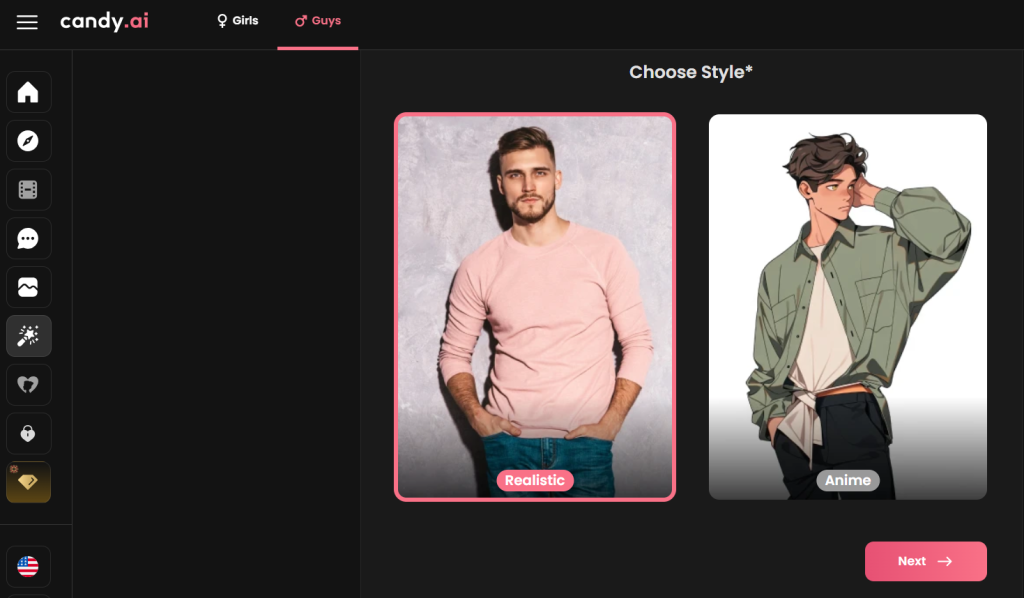
With a Candy AI boyfriend, you can choose a male character or create one with a custom appearance and personality. Chat, requested selfies and audio messages give you several ways to explore the attraction.
That makes Candy AI a relevant starting point if your wish list includes a handsome character, romantic conversation and a little visual chemistry. You can begin with the personality you fancy instead of treating a giant gallery as a challenge you need to finish.
Give the first conversation something to work with. You might ask him to choose a fictional date spot and defend his choice. A charming answer has more room to emerge when there is something to talk about beyond how gorgeous you both supposedly are.
If that sounds like your kind of distraction, explore Candy AI’s male characters and see which one catches your eye. Let the conversation earn the upgrade.
OurDream AI boyfriend lets you shape more of the story
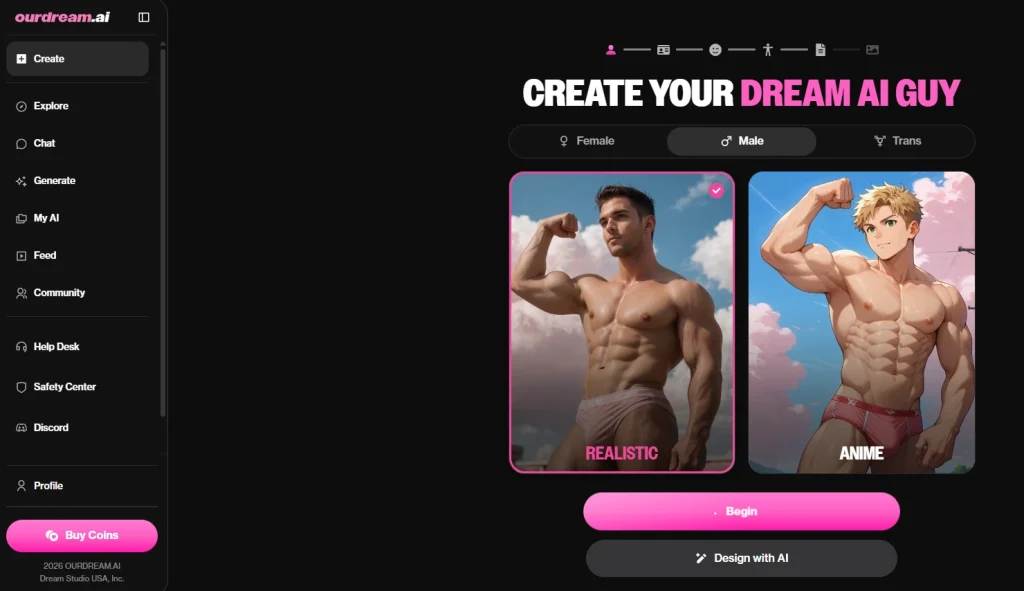
An OurDream AI boyfriend gives you male-character chat with tools for a continuing fictional relationship.
You can use pinned memories and custom instructions, and explore voice calls and generated images. Those controls can help organise a story; they do not guarantee flawless recall.
The OurDream AI boyfriend generator lets you shape his look, personality, voice, occupation and relationship dynamic, with realistic or anime styles. If your favourite romance takes its time, a little backstory gives the attraction somewhere to go.
Perhaps he is a fictional architect with a terrible sense of direction and a habit of flirting when he should be choosing a restaurant.
You have enough detail for a playful exchange without scripting every reply. Keeping the setup manageable also makes it easier to notice when the character wanders away from it.
If creating the character is half the fun for you, build an OurDream AI boyfriend around the kind of banter and romantic pace you enjoy.
Compare the details that could change your choice
| What you want to explore | Candy AI boyfriend | OurDream AI boyfriend |
|---|---|---|
| Choosing your fictional man | Male-character selection and custom character creation | Male characters and a custom boyfriend creator |
| Shaping his personality | Custom appearance and personality | Appearance, personality, occupation and relationship settings |
| Taking the chat beyond text | Requested selfies and audio messages | Image generation and voice calls |
| Guiding a continuing story | Start with a clear character setup and assess the conversation | Pinned memories and custom instructions provide additional controls |
| Keeping the purchase comfortable | Check the selected plan and any extra feature charges | Compare monthly and annual billing, plus dreamcoin use |
Compare the Candy boyfriend options and OurDream boyfriend options against the experience you have in mind. Your taste still does the choosing.
You may love a direct flirt, while someone else would happily spend an evening arguing playfully with a fictional man about his music collection.
AI girlfriend searches are larger, but attraction is personal
The US estimate for “AI girlfriend” is 135,000 monthly searches, compared with 22,200 for “AI boyfriend”. That puts the girlfriend phrase at roughly six times the volume in this comparison.
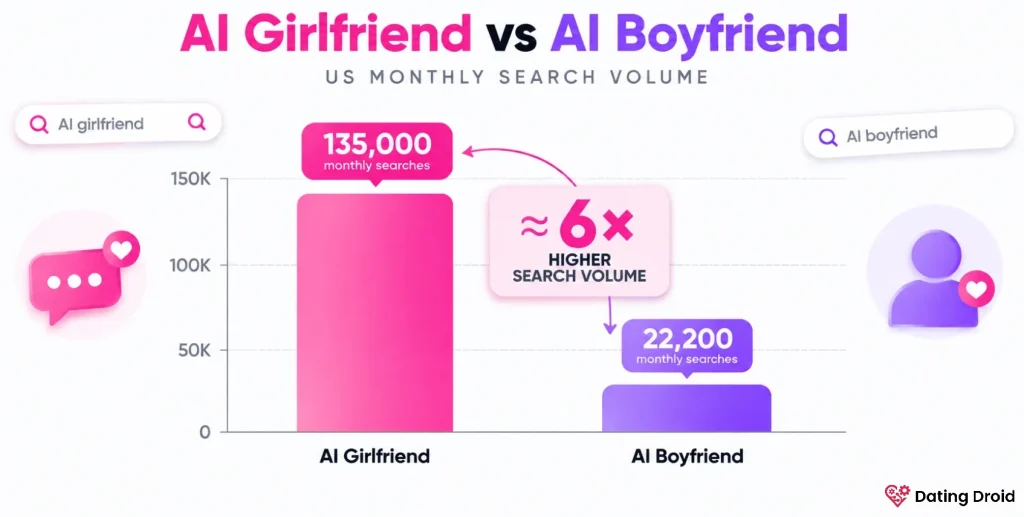
It’s a difference in search attention, not a count of relationships. It also tells us nothing reliable about the gender or sexual orientation of the person typing either phrase.
A woman, a man or a non-binary adult might want a male companion. Someone might enjoy more than one kind of character, or switch between romance and ordinary fictional friendship. The character’s gender is not a biography of the user.
More attention on one side of the market doesn’t make the other experience less worthwhile. You’re choosing the kind of conversation that appeals to you. There’s no prize for having the most statistically popular taste.
Who uses AI boyfriend apps?
There’s no dependable boyfriend-only demographic breakdown here that can put a percentage on women, age groups, LGBTQ+ users or people already in relationships. Search volumes can’t answer those questions.
You could be curious about interactive romance. You might enjoy a fictional crush, want to experiment with a character or simply fancy a playful distraction after work.
You don’t need a more dramatic reason than wanting to see if the chat makes you smile.
Those possibilities can overlap. Wanting an affectionate conversation tonight doesn’t mean you have stopped dating, and enjoying a fantasy doesn’t tell anyone whether you’re single.
If you have a partner, the practical question is how the experience fits the boundaries of your relationship.
Some couples may be comfortable with fictional flirting; others may draw the line differently. An app’s popularity can’t make that agreement for you.
Downloads are only the beginning
You also don’t need a demographic match to enjoy a character. A gallery aimed at one audience may still contain a style you like.
Pay attention to whether you feel comfortable with the conversation, the terms and the way the product treats you.

A download is a beginning. It doesn’t tell you whether someone had a good conversation, returned the next day or chose a male character at all.
An account can also hold more than one character. A person might start with a boyfriend, build a fantasy companion later and continue using the same subscription. Counting every character as a separate user would turn one person’s experiments into a very crowded dating life.
Browser access adds another wrinkle. Someone can use a service regularly without installing its mobile app. Equally, a download can sit forgotten after one disappointing exchange.
That’s why a large download badge should be a starting point for curiosity, rather than the deciding reason to subscribe. Read recent descriptions of the actual experience, and make time for your own first impression.
The same goes for messages. Hundreds of replies could mean a story was flowing beautifully, or that someone kept trying to get the character back on track. The amount of chat and the quality of chat are different things.
AI companion spending shows how much the wider industry has changed
There is serious money behind fictional company. Boyfriends share that business with AI friends, girlfriends and roleplay characters, so the wider figures cover more than male romance.
| Industry measure | Amount | Period | What it covers |
|---|---|---|---|
| Mobile companion consumer spending | $55 million | Full year 2024 | Appfigures’ tracked companion apps on the App Store and Google Play |
| Mobile companion downloads | 118 million | Full year 2024 | Downloads in that tracked mobile category; not unique people |
| Monthly mobile companion spending | $1.7 million | January 2024 | The broader tracked companion category |
| Monthly mobile companion spending | $8.8 million | December 2024 | The same historical category and monthly measure |
The historical mobile estimates come from Appfigures’ companion-app figures and monthly spending series. None is a boyfriend-only total or a measurement of the whole market in 2026.
Newer company figures show a different part of the business:
| Company measure | Amount | Date or period | What the number means |
|---|---|---|---|
| CHAI annual recurring revenue | More than $80 million | End of Q1 2026 | Company-reported annualised revenue pace across its social AI business |
| CHAI annual revenue run rate | About $100 million | July 2026 update | Company-reported pace, presented as ARR in the update’s headline |
CHAI’s Q1 2026 figure and July update describe an annualised pace, not audited revenue earned over a completed year. They also include experiences beyond AI boyfriends.
Adding them to the mobile spending table would mix different measures and potentially count some money twice.
A subscription is still an entertainment purchase. It should fit your budget and give you an experience you actually use. Affectionate language in the chat doesn’t change what is happening at checkout.
Our AI companion revenue guide covers the broader business picture. For choosing your own app, the more relevant number is the amount leaving your account.
Your AI boyfriend budget needs more than the headline price
Your actual bill depends on the plan, billing period, currency and any extras you choose. A useful budget starts with the way you want to use the app.
Start with the full payment. A plan advertised as a monthly equivalent may require a year upfront. That can be reasonable once you know you like the service, but it’s a bigger commitment than trying a single month.
Then check what the payment includes. Text chat, voice calls, images and extra characters may have different allowances. The feature that caught your attention in a preview might use a separate credit balance.
OurDream gives you a concrete example of why the billing period matters. At September 2026 base prices, monthly membership is US$19.99, while annual membership is US$119.88 upfront, equivalent to US$9.99 a month.
Both include unlimited messages and 1,000 dreamcoins each month. OurDream membership options
| OurDream payment choice | Base payment | Effective monthly cost | Twelve months at the stated rate |
|---|---|---|---|
| Monthly membership | US$19.99 each month | US$19.99 | US$239.88 |
| Annual membership | US$119.88 upfront | US$9.99 | US$119.88 |
That is a US$120 difference across twelve months if those rates stay the same and you keep paying all year.
Extra purchases, applicable taxes and currency conversion can change the bill. The annual option only saves you money you would otherwise have spent; an unused subscription is still an unused subscription, however lovely his profile picture is.
A little flirting can make an upgrade feel tempting. Decide your limit while you’re looking at the numbers, before a conversation gives the next purchase emotional weight.
Also find the cancellation route before subscribing. Removing an app icon and cancelling a recurring payment are different actions.
Our AI girlfriend subscription cancellation guide covers billing checks that are useful for companion accounts more broadly.
Returning to an AI boyfriend doesn’t automatically mean a better experience
An ongoing character can become part of a pleasant routine. You might return to continue a fictional date, pick up a joke or see where a story goes next. Those are perfectly understandable reasons to open an entertainment app again.
A subscription can keep renewing after someone has lost interest, while a happy free user may never pay at all. Coming back, enjoying yourself and renewing a plan are separate parts of the experience.
Your own reason for returning matters more than a promised industry average. Are you looking forward to the conversation, or trying to recover a character that no longer behaves the way you enjoyed? Does the app fit into your evening, or keep stretching it past the point you intended?
You can enjoy an AI boyfriend without making daily attendance part of the arrangement. Missing a chat doesn’t require an apology or a purchase. If the experience stops being enjoyable, changing the character, reducing use or leaving is a reasonable choice.
Our AI companion retention guide explains the difference between returning users and renewed subscriptions.
Romantic chat and NSFW chat are different preferences
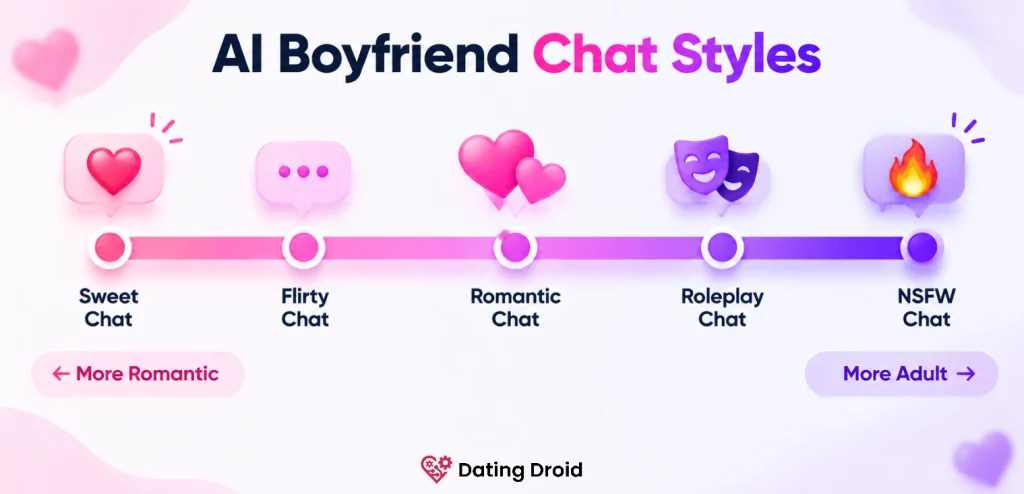
An AI boyfriend can be appealing because he flirts, because he plays a part in a story or because the conversation feels affectionate. That doesn’t mean every user wants explicit content.
You might want the anticipation of a first date without taking the conversation further. A suggestive joke can be enough, especially if you enjoy a character who leaves room for you to flirt back.
If you’re choosing an adult chat experience, think about the tone you actually enjoy. You may want a little teasing and a slow build. You may prefer straightforward romance, with the conversation staying affectionate rather than sexual. The option to steer that pace matters.
“Unfiltered” is also a product label, not a guarantee that every request is supported or that the conversation is private. Check the service’s adult-content rules and age requirements before paying for an experience you expect it to provide.
Choose a character who lets you enjoy the mood you came for. You should be able to keep a fictional flirtation light without every exchange being pushed somewhere else.
A personal conversation still needs sensible privacy boundaries
An AI boyfriend may invite intimate conversation, but the app remains a digital service. A nickname and a fictional backstory can give you plenty to talk about without handing over your real address, workplace or private documents.
Be especially careful with details that belong to other people. Your ex’s messages, a colleague’s photograph or a partner’s personal history are not necessary ingredients for a fictional romance.
Before a chat becomes personal, find out what you can delete and what happens to saved memories. Clearing a visible conversation, deleting a character and closing an account may involve different controls.
You can also pause before using image or voice features. An extra sense of closeness doesn’t require sharing more than you’re comfortable with.
Our AI companion privacy guide looks at these questions in more detail. A charming character is easier to enjoy when you understand the account behind him.
How the AI boyfriend industry is evolving

The product is becoming more than a chat window with a handsome profile picture. Character creation, voice, images and continuity controls can now sit inside the same companion experience.
You might arrive for a quick flirt and discover that building the fictional man is just as entertaining as talking to him.
That changes the questions worth asking. “How many characters are there?” only gets you so far. You also want to know whether he keeps the personality you chose, whether his voice suits him and whether the next conversation feels connected to the last one.
Personalisation is moving beyond appearance
Choosing hair and eye colour gives a character a look. Setting his conversational style gives you something to respond to.
A romantic AI boyfriend who is curious, lightly teasing and comfortable with a slower pace creates a different experience from one who rushes into pet names before you have chosen a fictional first date.
The combination of character settings and continuing chat is what makes this category interesting. A finished image gives you someone to look at. An adjustable personality gives you a story you can participate in.
Candy AI’s custom male characters and OurDream’s boyfriend creator are examples of that direction. The practical question is whether the resulting conversation feels distinctive enough for you to enjoy returning. More sliders do not automatically create more chemistry.
Voice and images are becoming part of the same experience
Text leaves plenty to the imagination. Audio adds a particular rhythm, and images give the fictional character a more consistent visual presence.

Together, those features can make an interaction feel more personal without turning the software into a person.
They also change the purchase. Someone who mainly wants romantic chatbot messages has different needs from someone who wants voice calls and regular image generation. “Unlimited chat” is only the whole offer if chat is all you want.
That is why a plain explanation of allowances becomes more useful as products add features. You should be able to tell what another evening of your preferred experience might cost before you buy it.
An easy start still has to lead somewhere enjoyable
The 2026 free-chat and no-sign-up searches suggest that the first impression matters. People can be curious without being ready to register, subscribe or design an elaborate character.
An easier start can help you find out whether you enjoy the idea. Keeping the experience worthwhile takes something else: a chat that develops, controls you understand and a price you remain comfortable paying.
The industry can grow while individual products disappoint. A larger market does not make every subscription a good match, any more than a crowded dating app guarantees a lovely first date.
AI boyfriend trends for 2027: what could change next?
Our 2027 outlook is a set of predictions based on current products and 2026 search patterns. It is not a measured result or a forecast of boyfriend-only revenue.
The most plausible changes concern how these experiences work, how you pay and how much control you have over them.
| Possible change in 2027 | What points in that direction now | What it could mean for you |
|---|---|---|
| More control over continuing stories | Character settings, pinned memories and custom instructions already exist | More ways to correct details and keep the romantic pace you enjoy |
| More combinations of chat, voice and images | Current companion products already connect several formats | A richer experience, with more allowances to compare before paying |
| More competition around the first conversation | Free-chat and no-sign-up searches strengthened between January and July 2026 | Easier trials could become a stronger selling point |
| More attention to the real monthly bill | Subscriptions and separate feature credits can sit alongside each other | Clearer spending controls could become a reason to choose one app over another |
| More variation in access by country | Age rules and proposed restrictions differ between jurisdictions | Registration and age checks may depend more on where you live |
A boyfriend who remembers the mood could matter more than another new face
Our expectation is that continuity will become a stronger selling point in 2027. Once you have found a character you enjoy, an even bigger gallery may be less tempting than being able to continue yesterday’s story without starting again.
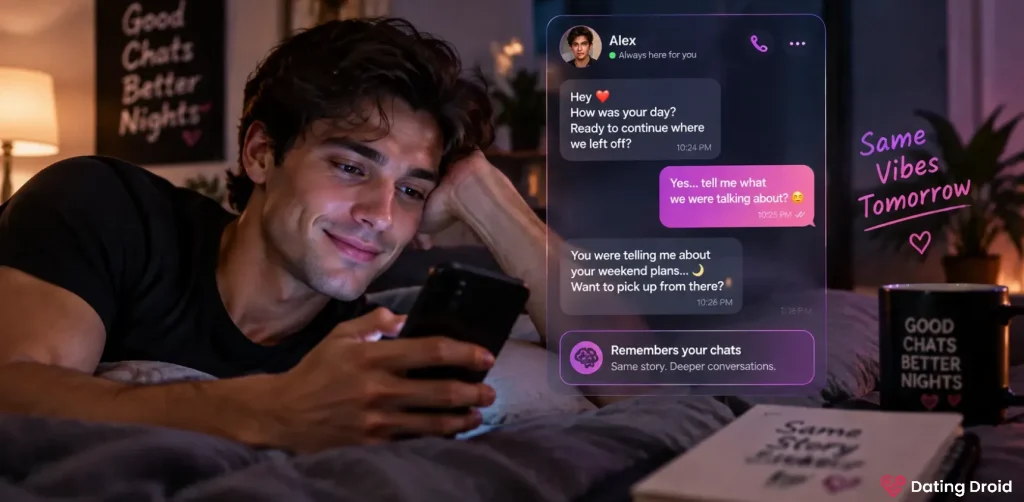
The improvement to look for is practical. Can you correct a detail? Can you change a personality setting that is not working?
Does the character keep the gentle teasing you asked for without turning every reply into a declaration?
Better control would make an AI boyfriend with memory more useful. It still would not make his recall perfect or give him human feelings. The appealing part is having more say in a fictional experience you enjoy.
Easier trials could meet stronger age checks
The appetite for an easy start may run into a different pressure: proving who can access an adult service. Those two trends can develop at the same time.
In June 2026, the UK announced plans for an 18+ minimum on romantic companion chatbots designed to simulate sexual relationships or roleplay.
The wider package’s first regulations could take effect in spring 2027; that is an announced timetable, not a guarantee that every proposed chatbot measure starts on the same day. UK announcement and proposed timetable
For adults, the useful questions concern what information a check needs, who handles it and what is retained. A welcoming first conversation and a clearly explained age check can coexist. Neither needs to be wrapped in confusing promises about total anonymity.
More immersive features may make value harder to compare
We expect more attention to the cost of the complete experience in 2027. A low entry price can look less appealing if the voice or image feature you enjoy uses a separate balance quickly.
A useful comparison could be as simple as asking what your normal week would cost. If you mostly type, that may be close to the subscription alone. If you regularly call and generate images, the allowances become part of the decision.
An app does not need to offer everything to be worth your money. It needs to do the things you want at a cost that still feels good after the novelty settles.
Choose the conversation you want to have
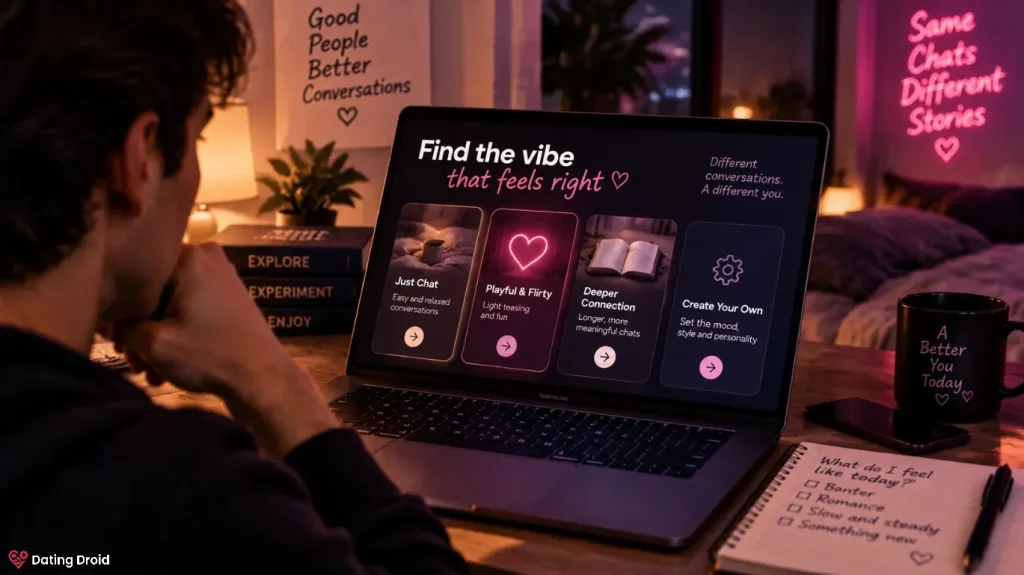
The search numbers give you several useful starting points: free access, character creation, a browser chat or a particular companion app. None of them can predict your chemistry with a fictional personality.
If you are comparing the best AI boyfriend apps, choose two or three that fit your priorities and give each a fair first conversation. You do not need to turn finding a fictional crush into a second job.
Try a conversation that resembles the experience you’d actually return for. If you want playful banter, start there. If you enjoy a longer romantic storyline, give the character a simple setting and see whether the exchange develops without constant corrections.
Notice the ordinary moments as well as the flattery. A good response to a change of subject can tell you more than another declaration of affection. So can the way the character reacts when you say you want to slow down or end the chat.
Keep the role of the app clear. It can be entertainment, fictional company or a place to experiment with dialogue. It’s not a substitute for professional care when you need help with persistent distress.
You don’t have to turn a pleasant chat into a serious commitment. Sometimes enjoying a little digital chemistry is enough.

Stay Updated with Us
Let the numbers inform your choice and the chat earn your time
AI boyfriend search demand is visible across several markets, with the US leading this comparison and people looking for everything from free chat to custom characters.
The most useful choice still happens after you open the conversation.
Start with the experience you want, give the character room to show his style and keep the cost comfortable.
You’re allowed to enjoy an attractive fictional man who makes you smile. He just needs to be interesting enough to deserve the next message.