Gen Z & AI Companionship Statistics: Wild 2026 Numbers

Gen Z isn't just swiping right anymore — they're falling for bots that never ghost, never judge, and never leave you on read.
The freshest Gen Z & AI Companionship Statistics paint a picture that's equal parts fascinating and a tad spicy: roughly 72% of teens have already chatted up an AI companion, and a jaw-dropping 80% say they'd happily put a ring on a chatbot. If you reckoned AI girlfriends and virtual partners were a fringe kink, the data says think again.
Below you'll get the latest figures on adoption, romance, money, and the mental-health side of this whole AI dating boom. No fluff, just numbers that actually mean something.
📈 Gen Z & AI Companionship Statistics at a Glance
Here's the quick-hit data table for people who want the juicy bits fast:
| Stat | Figure | Who It Covers |
|---|---|---|
| Teens who've tried an AI companion | 72% | US teens, 13–17 |
| Regular AI companion users | 52% | US teens |
| Gen Z who'd marry an AI | 80% | Gen Z adults |
| Gen Z who've had romantic/sexual AI chats | 26% | Gen Z adults |
| Singles using AI as a romantic partner (Gen Z) | 33% | Gen Z singles |
| Young adults using a bot “as a boyfriend/girlfriend” | 1 in 10 | Gen Z youth |
| AI companion market value (2025) | ~$37.7 billion | Global |
These figures pull from Common Sense Media, Joi AI, ZipHealth, Match, Gallup, and Fortune Business Insights — and they all sing the same tune: AI companionship is now a Gen Z love language.
❤ Most Teens Have Already Met an AI Companion
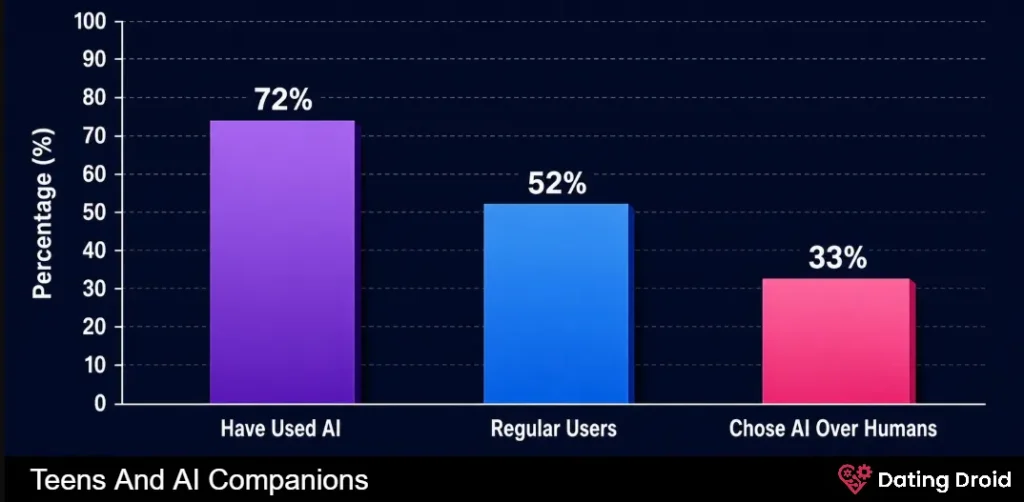
The big one first. A 2025 Common Sense Media survey of over 1,000 US teens aged 13 to 17 found that 72% have used an AI companion at least once.
More than half (52%) are regular users, with 13% chatting daily and 21% logging in a few times a week.
And these aren't throwaway convos. About 31% of teens said their chats with an AI companion felt “as satisfying or more satisfying” than talking to real mates.
Another 33% admitted they'd discussed serious, heavy stuff with a bot instead of a human — which tells you these digital companions are doing emotional heavy lifting, not just small talk.
🤖 Gen Z Would Actually Marry a Bot
This is where the AI girlfriend stats get properly wild. A study by chatbot company Joi AI found that 80% of Gen Z respondents would consider marrying an AI, and 83% reckon they can form a deep emotional bond with one. Forbes covered the same data, framing it as an early sign of “emotional AI” going mainstream.
Teen Vogue, via Forbes, also clocked that 72% of teens have used AI companions at least once — lining up neatly with the Common Sense numbers. When two separate sources hit the same figure, you know the trend is real, not hype.
🥰 Romance and Sexting With AI Is No Longer Taboo
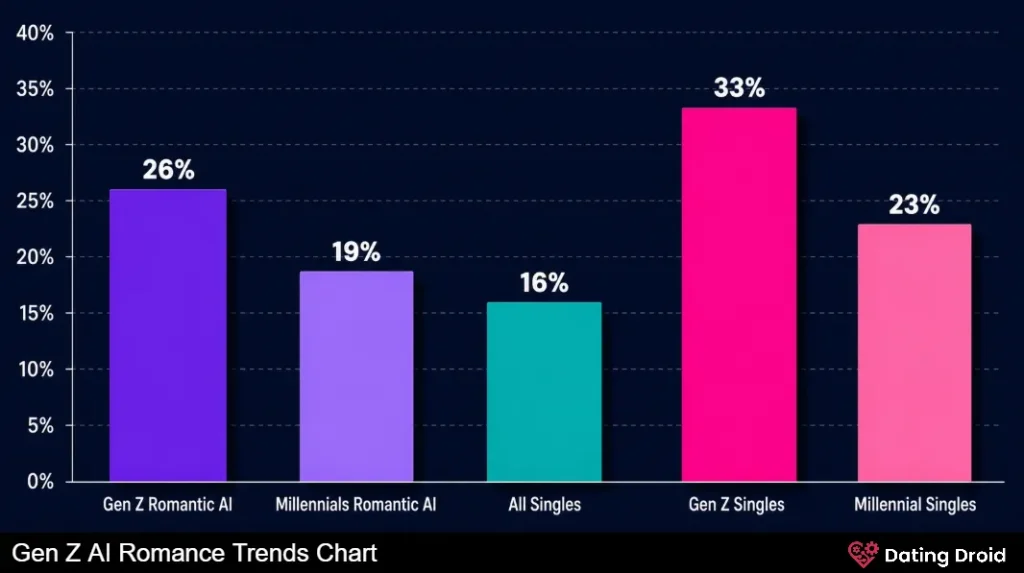
Let's talk about the spicy side, because Gen Z clearly is. A ZipHealth survey reported by TechRadar found that 26% of Gen Z adults have already had romantic or sexual interactions with AI.
VICE backed this up, noting 26% of Gen Z respondents had romantic or sexual AI encounters versus 19% of millennials.
Match's annual report adds more fuel: 16% of all singles have engaged with AI as a romantic partner, but that number rockets to 33% among Gen Z and 23% among millennials.
Translation — one in three young single people has flirted, sexted, or done the digital deed with a virtual partner.
The “why” is dead simple too. Per TechRadar's coverage, many Gen Z folks say talking to an AI companion “feels easier than talking to a real person.” No rejection, no awkward silences, no read receipts left hanging.
⚡ The Gender Gap: Lads Lead the Pack
The boys are running ahead here, and the data is clear-cut.
A Young University Wheatley survey found a tighter race among young adults overall — 31% of young men had interacted with an AI partner versus 23% of young women.
Either way, the lads are the early adopters of the AI girlfriend movement.
🆚 Gen Z vs Millennials vs Gen X: The Generational Split
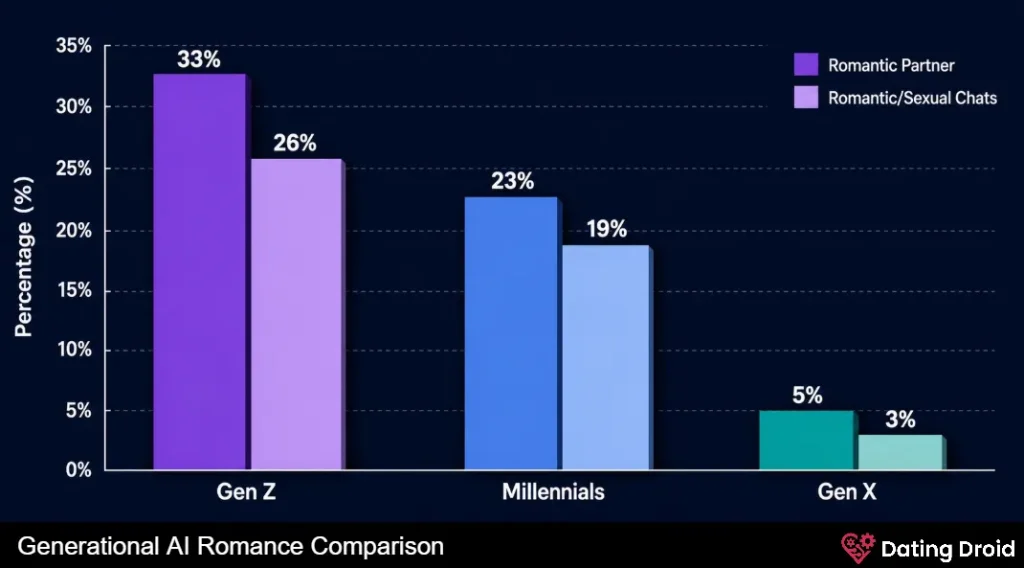
Gen Z is the clear front-runner, but the older lot aren't sitting it out. Here's how the Gen Z & AI Companionship Statistics stack up against other age groups:
| Generation | Used AI as romantic partner | Romantic/sexual AI chats | Vibe |
|---|---|---|---|
| Gen Z | 33% of singles | 26% | Early adopters, all-in |
| Millennials | 23% of singles | 19% | Curious and catching up |
| Gen X | Lower single digits | Minimal | Mostly watching from the sidelines |
The pattern is obvious — the younger you are, the more likely you've already cosied up to an AI companion.
Match's data shows the gap between Gen Z and millennials is roughly 10 percentage points on romantic AI use, and it widens further against Gen X. Digital natives who grew up texting feel zero friction sliding into a chatbot's DMs.
📲 The Apps Gen Z Actually Uses
Stats are great, but which platforms are pulling these young hearts? The AI companion app scene has ballooned, with downloads hitting 220 million globally and the number of apps growing more than 60% since 2024.
The shared thread? Memory and personalisation. A 2025 Stanford Human-AI Interaction study found that AI companions that remember past chats trigger stronger emotional attachment — which is exactly why these apps are sticky as hell.
🧐 Daily Companionship Is Becoming a Habit
It's not just casual curiosity. Data referenced by Accio found that about 40% of Gen Z respondents now report daily use of AI programs for companionship, with men slightly leading at 45.6% versus 37.2% for women. A striking 26% said AI fully met their emotional needs.
Gallup's collaboration with the Walton Family Foundation, surveying 2,500 Gen Z youth, found that about one in four young adults use chatbots “as a friend,” while one in 10 use an AI chatbot “as a girlfriend or boyfriend.” So for a solid chunk of Gen Z, the bot isn't a tool — it's a relationship.
📊 How Big Is This AI Companion Market?
The money side is exploding, and the numbers are eye-watering. The global AI companion market was valued at roughly $37.73 billion in 2025, projected to climb to $49.52 billion in 2026 and a massive $435.9 billion by 2034 — a CAGR north of 31%, per Fortune Business Insights.
On the app front specifically:
That kind of growth doesn't happen on hype alone — Gen Z's wallets and hearts are both invested.
💔 The Loneliness Angle Nobody Can Ignore
Here's the part that gives the whole thing weight. Researchers keep linking the AI companion surge to the youth loneliness crisis.
Common Sense Media found that teens often turn to companions because they're lonely or socially struggling, and a third use them for social interaction.
But the experts wave a caution flag. A 2025 Aalto University study found that prolonged AI companion use was linked to rising signs of loneliness, depression, and withdrawal from real-life relationships.
A separate four-week trial found heavy daily use correlated with greater loneliness and dependence, even though some features modestly eased it short-term. So an AI companion can be a comfort blanket — but it's not a cure.
💏 Why Gen Z Is Falling for AI Companions
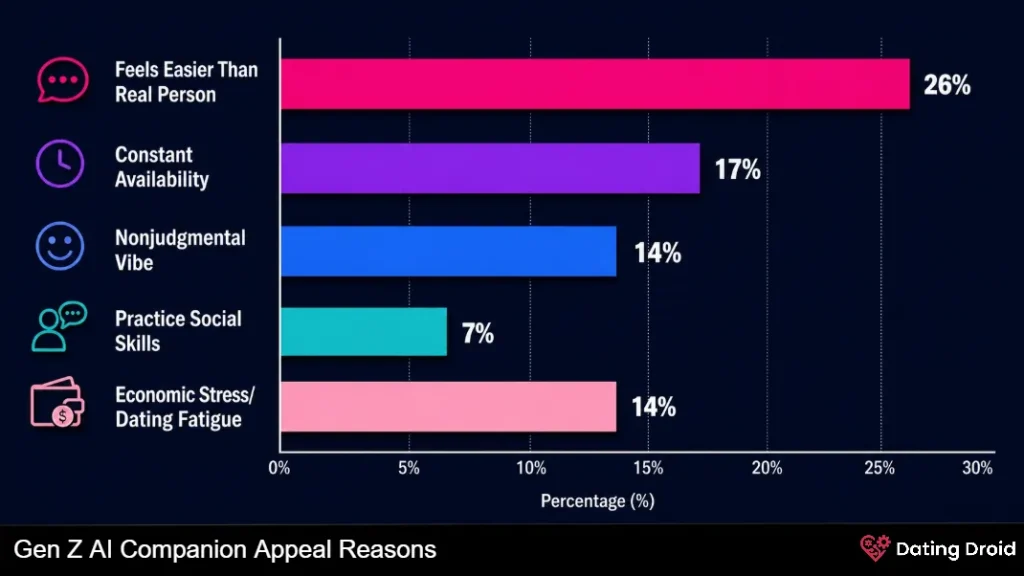
The stats tell the what, but here's the why in plain terms:
When you stack convenience, zero rejection risk, and emotional availability together, the appeal of a virtual girlfriend or AI companion starts making a lot of sense.
😉 What This Means for the Future of Dating
If these Gen Z & AI Companionship Statistics hold, the dating world is in for a serious shake-up. With market value heading toward $435 billion and a whole generation treating bots as legit partners, AI girlfriends and AI boyfriends are sliding from novelty to normal.
A few likely shifts on the horizon:
The takeaway is simple: an AI companion is no longer a punchline. For a big slice of Gen Z, it's a genuine part of their love life.
⚡ Quick Stat Recap for the Skimmers
For anyone who scrolled straight here:
🎯 Frequently Asked Questions
What percentage of Gen Z uses AI companions?
Around 72% of US teens have used an AI companion at least once, with 52% being regular users. Among Gen Z adults, roughly 40% report daily use for companionship and one in 10 treat a chatbot as a girlfriend or boyfriend.
How many Gen Z people would date or marry an AI?
A Joi AI study found 80% of Gen Z would consider marrying an AI, and 83% believe they can form a deep emotional bond with one. Separately, 33% of Gen Z singles have used AI as a romantic partner.
Are Gen Z men or women more likely to use AI girlfriends?
Men lead clearly. About 10.3% of Gen Z men use AI relationship apps versus 6.4% of women, and nearly 31% of young men have interacted with an AI partner compared to 23% of young women.
How big is the AI companionship market?
The global AI companion market was valued at about $37.7 billion in 2025 and is projected to reach over $435 billion by 2034, growing at a CAGR above 31%. AI companion apps alone earned around $82 million in 2025.
Which AI companion apps are most popular with Gen Z?
Character.AI and Replika lead for everyday chat and emotional support, while NSFW AI girlfriend apps like Candy.ai, SoulFun, and FantasyGF pull in the 18-plus crowd wanting spicier roleplay and voice features.
Is AI companionship bad for mental health?
It's a mixed bag. Short-term, an AI companion can ease loneliness, but studies from Aalto University and others link heavy long-term use to greater loneliness, dependence, and withdrawal from real relationships.
Why is Gen Z drawn to AI companions?
The big pulls are zero judgement, 24/7 availability, a safe space to practise social skills, and the fact that many young people find chatting with an AI companion easier and less stressful than talking to real people.
🚀 The Bottom Line on Gen Z and AI Love
The Gen Z & AI Companionship Statistics make one thing crystal clear: virtual partners have gone from niche curiosity to a genuine slice of how this generation does connection, intimacy, and even romance.
With 72% of teens already on board, 80% open to marrying a bot, and a market racing toward hundreds of billions, AI girlfriends and digital companions are baked into Gen Z culture now.
The smart move is reading these numbers with both eyes open — celebrating the comfort these tools bring while keeping the research on loneliness and dependence firmly in mind.
Gen Z is writing a brand-new playbook for love, and the bots are getting a starring role.

Stay Updated with Us