AI Dating vs Traditional Dating App Statistics: 2026 Trends

A few years back, paying $40 a month to chat with a virtual girlfriend sounded like some dystopian Black Mirror side plot. Now? It's a booming multi-billion-dollar industry — and it's quietly making Tinder's finance team question all their life choices.
The 2026 numbers on AI dating vs traditional dating app statistics tell a story the swipe-app giants are absolutely not putting in their investor decks. Downloads falling for six straight years.
First-ever revenue decline. And on the other side of the fence — AI companion apps posting 25%+ growth, clocking 28 minutes of daily engagement, and building a loyal user base that doesn't ghost, doesn't charge for boosts, and is available at 3am without complaint.
Here's the full breakdown, properly sourced, no spin.
🆚 TL;DR — AI Dating vs Traditional Dating App Statistics at a Glance
For the skimmers: here's the state of play in one table.
| Metric | Traditional Dating Apps | AI Companion / Dating Apps |
|---|---|---|
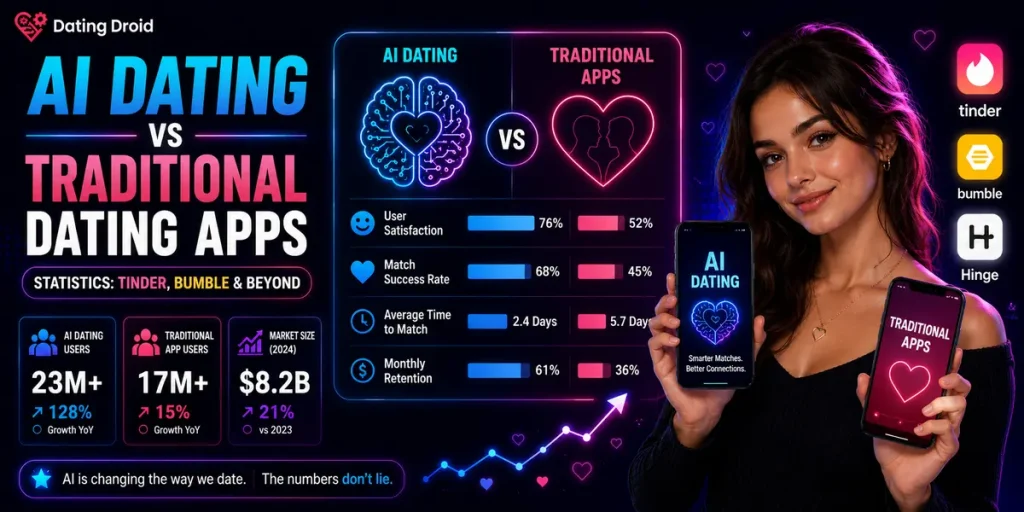
| Global Revenue (2025) | $6.07B (down YoY) | $2.32B–$3.08B (up 25.5% YoY) |
| Daily Time Spent | ~9 mins/day (65 min/week) | 28 mins/day |
| Download Trend | Falling 6 consecutive years | 128 new apps launched in 2025 alone |
| Monthly Churn | 69% delete within first month | 60%+ retention after month 1 |
| Rejection Risk | Very real | Literally zero |
| Availability | Depends on matches | 24/7, no excuses |
The swipe economy is stalling. The AI romance market is accelerating. Both things are true at the same time.
📊 The State of Traditional Dating Apps in 2026
The headline stats look okay until you scratch the surface — then it gets a bit grim.
Tinder by the Numbers
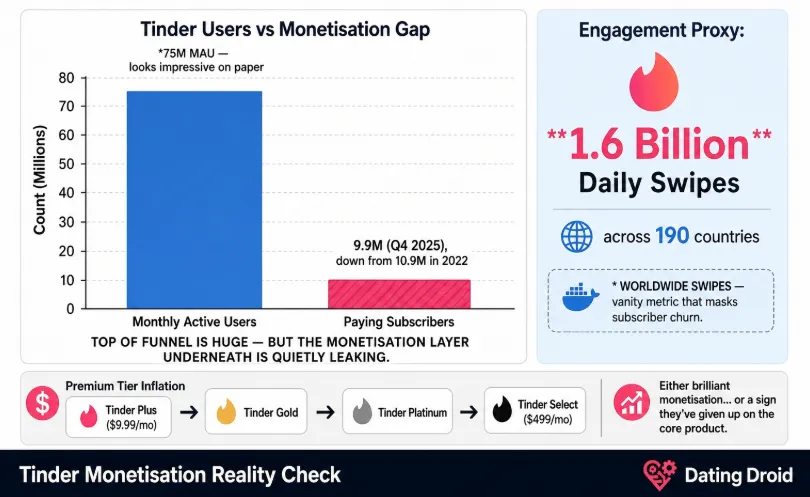
Tinder still sits at 75 million monthly active users and 1.6 billion daily swipes across 190 countries. Impressive on paper. But paying subscribers dropped from 10.9 million (2022) to 9.9 million in Q4 2025, and full-year revenue slid from $1.95B (2024) to $1.89B — a 3% decline year on year.
In the UK alone, Tinder shed 594,000 users between May 2023 and May 2024. The top of the funnel still looks big. The monetisation layer underneath is quietly leaking.
Tinder's response? Tack on more premium tiers. You've now got Tinder Plus at $9.99/month all the way up to Tinder Select at a bonkers $499/month — an invite-only, curated-match experience that is either genius monetisation or a sign they've fully given up on fixing the core product. Probably both.
Bumble's Rough Patch
Bumble went from 58 million users in 2023 down to roughly 50 million by 2026. Downloads fell 19%. The company cut staff and started hosting physical in-person events because the app itself stopped holding people's attention. That's not a growth strategy — that's a product team in damage control.
Full-year 2025 revenue was $1.07B — up just 1.9% year on year. Paying users across Bumble and Badoo combined hit 4.1 million in Q4 2025. ARPU is roughly $15/month, the lowest among the major players. For context, Bumble IPO'd at a $7.7B valuation in 2021. Current market cap sits around $3.2B. Rough.
Hinge — The Lone Bright Spot
Not all doom and gloom on the traditional side. Hinge grew full-year revenue 26% to $691M, added paying users (1.7 million in Q4 2025, up from 1.3 million), and is pulling the highest ARPU in the industry at around $34/month.
Its “designed to be deleted” pitch and deeper onboarding keeps users more invested than Tinder's swipe-and-ghost loop. Among a flatlining cohort, Hinge is the one still breathing properly.
The Whole Market Is Flatlining
Here's the number no one in Silicon Valley is framing on their office wall:
Dating app revenue fell for the first time ever — from $6.18B in 2024 to $6.07B in 2025. Downloads have declined for six consecutive years since the 2019 peak of 287 million.
Average weekly usage is down to 65 minutes. Match Group stock has cratered. The apps are scrambling to bolt AI features onto products that users are already thoroughly sick of. When your pivot strategy is hosting in-person speed-dating events, your app has a problem.
📈 The Rise of AI Dating & AI Girlfriends
While swipe apps bleed subscribers and confidence, the AI companionship space is printing money.
How Big Is the AI Girlfriend Market?
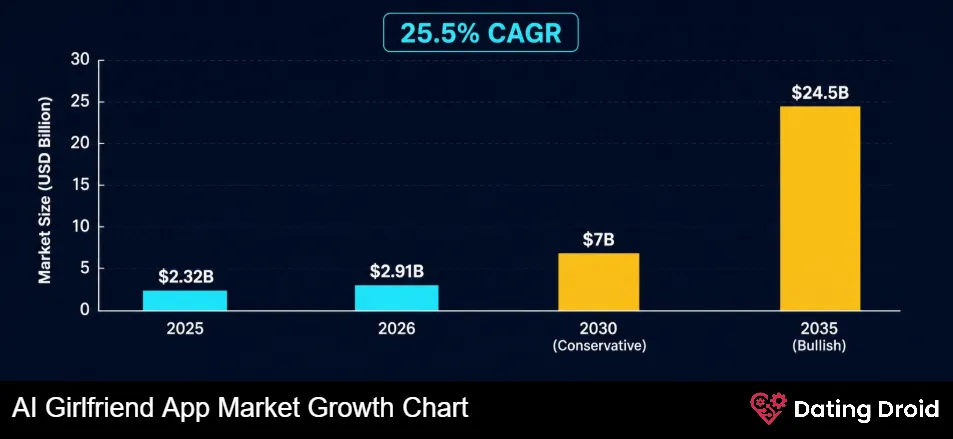
The AI girlfriend app market was valued at $2.32 billion in 2025 and is set to hit $2.91 billion in 2026 — a 25.5% CAGR that traditional dating apps would kill for. Conservative projections put the sector at $7–9B by 2030. Bullish ones go as high as $24.5B by 2034–2035.
Right now, there are 337 active, revenue-generating AI companion apps worldwide. 128 of those launched in 2025 alone — roughly 21 new apps every single month. Candy AI is doing $25M ARR fully bootstrapped with over 1 million daily interactions. Chai AI — running on 12 employees — posts $30M+ ARR. This isn't a niche. It's a proper market.
How Long People Actually Spend
Character.AI clocks a 28-minute average session length — longer than Instagram. Let that sink in. People are spending more time per day chatting with an AI companion than scrolling through Reels. That's either a testament to how genuinely engaging modern AI sex chat apps have become, or a sharp comment on how little real-world dating apps are delivering. Honestly, probably both.
Engagement & Stickiness
Over 55% of AI girlfriend app users chat daily. DreamGF reports 60% user retention after month one. FantasyGF AI posts a 70% engagement rate on its premium tier. Compare that to traditional dating apps where 69% of users delete the app within the first month of downloading it. The AI companion model is stickier, simpler, and — for a large chunk of users — just more satisfying.
📲 Head-to-Head — AI Dating vs Swipe Apps
Let's get granular.
⏱ Time Spent
AI companion apps: 28 minutes per day. Traditional dating apps: 65 minutes per week, which works out to roughly 9 minutes a day. AI wins by a mile on daily engagement.
Users aren't half-heartedly swiping while watching telly — they're having full-blown conversations, doing AI sexting roleplay, sending voice messages, and building ongoing interactions that actually hold their attention.
🔄 Retention vs Churn
Traditional app churn is brutal. 69% of downloads result in deletion within 30 days. Users swipe, fail to match, get ghosted, hit the paywall, and bail. AI companion apps flip this entirely — 60% month-one retention puts them closer to a solid SaaS product than a dating app.
Once someone builds a dynamic with their virtual girlfriend, they don't just delete it on a frustrated Wednesday night.
💸 Cost to the User
| App | Entry Subscription | Premium Tier |
|---|---|---|
| Tinder | $9.99/month (Plus) | $499/month (Select) |
| Bumble | $19.99/month (Boost) | $39.99/month (Premium) |
| Hinge | $34.99/month (Hinge+) | $49.99/month (HingeX) |
| AI GF Apps (avg) | $9–$19/month | $29–$47/month |
Revenue per download on AI companion apps jumped from $0.52 to $1.18 in a single year — a 127% spike in monetisation efficiency. Meanwhile, Tinder is charging $500/month for a tier that still can't guarantee a decent date.
📈 Growth Direction
One market is going up. One is going sideways at best, declining at worst. That's genuinely the simplest, cleanest summary of 2026's dating app landscape.
⚡ Why Blokes Are Swapping Swipes for AI Companions
Dating apps built their entire model on friction — swipe, match, get ghosted, pay for a boost, repeat. People got tired.
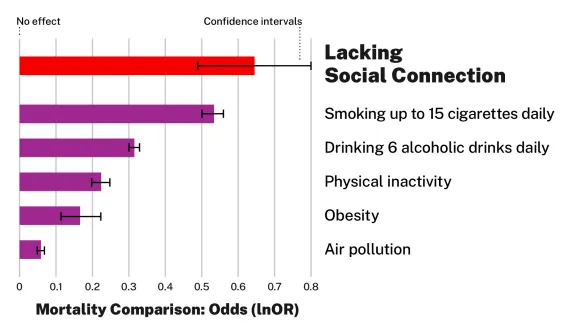
The US Surgeon General flagged loneliness as a public health crisis, equivalent to smoking 15 cigarettes a day. 30% of American adults report feeling lonely weekly. AI girlfriend apps showed up and surgically removed every pain point that made traditional apps miserable:
A BYU study of nearly 3,000 participants found that 31% of men aged 18–30 and 23% of women in the same bracket have used an AI romantic companion. Among high schoolers, it's 1 in 5.
Experts aren't shy about the flip side either — dependency, financial exploitation through token systems, and users losing the social muscle for real-world connection are real concerns.
Only 12% of AI girlfriend companies have published ethical development guidelines. 68% lack proper privacy policies. The product is moving considerably faster than the responsibility around it.
🌐 What the Data Says About the Future
Match Group is in strategic survival mode — layoffs, stock collapse, pivoting to in-person events, and announcing AI features for 2026 that they're billing as 15–25% premium pricing justifications. Bumble's 2026 “reinvention” is an open admission that the old swipe format is cooked.
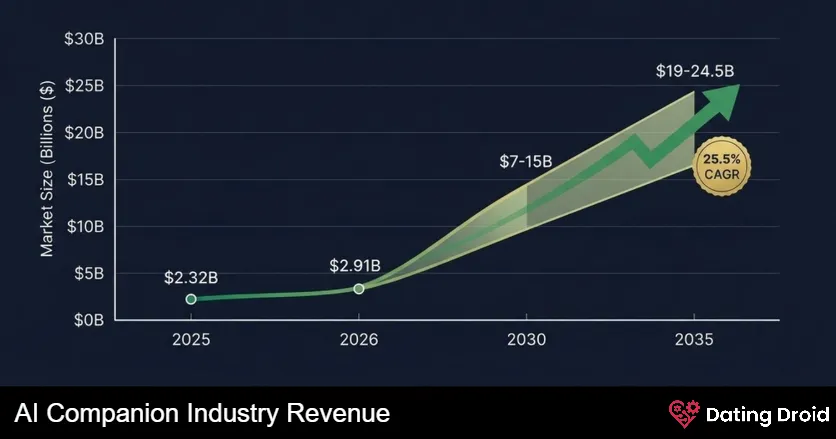
Meanwhile, the AI companion market keeps climbing:
The apps that survive the swipe-app slump are already integrating AI — smarter matching, AI icebreakers, conversation coaching, profile analysis. Hinge's strong growth proves depth beats volume. The rest are playing expensive catch-up.
The AI dating and virtual girlfriend market isn't having traditional apps for breakfast quite yet. But it's sitting at the same table, eating their lunch.
🚀 FAQs
Is AI dating more popular than Tinder in 2026?
Not by raw user count — Tinder still holds 75M monthly active users. But AI companion apps are growing faster and pulling 3x the daily engagement with no signs of slowing down.
How much is the AI girlfriend market worth?
The AI girlfriend market hit $2.32B–$3.08B in 2025 and is projected at $2.91B in 2026, with long-range forecasts going as high as $24.5B by 2035.
Why are dating app downloads falling?
Swipe fatigue, aggressive paywalls, rampant ghosting, and the creeping suspicion that these apps are built to keep you lonely and subscribed — not actually find you someone.
Do people spend more time on AI girlfriends than dating apps?
Yes. AI companion apps average 28 minutes per day vs traditional dating apps' 9 minutes per day. That gap says everything.
Are AI girlfriends replacing real relationships?
Not quite yet — but they're absolutely replacing the frustration of traditional dating apps, and the engagement numbers back that up hard.
✨ Methodology & Sources: How We Pulled These Statistics
Data sourced from Business of Apps Dating App Report, Match Group and FY2025 SEC filings, Bumble Inc. earnings, Grindr earnings, SNS Insider AI Girlfriend App Market Report, Grand View Research online dating forecast, BYU loneliness study (n=2,969), Adjust State of Dating Apps, 5W PR Dating App AI Visibility Index, and GIS User analysis.
All figures are from publicly available reports published between 2025–2026.

Stay Updated with Us