AI Dating Profile Feedback: Fix Hinge or Bumble Profile Fast


AI dating profile feedback works best as an editor, not a personality transplant. Give it your real details, ask it to identify generic lines and missing conversation hooks, then rewrite the answer yourself.
Hinge now offers Prompt Feedback, and Bumble announced AI-suggested Profile Guidance in 2026. Those native tools are the safest first stop because you do not need to upload your entire profile to a random screenshot app.
The winning profile is not the smoothest one. It is the easiest one to reply to. Keep one specific detail, one glimpse of your vibe and one low-effort opening for a match. If AI turns you into a taco-loving travel addict who is “fluent in sarcasm,” fire the robot.
💓 What AI Dating Profile Feedback Can Actually Fix
Most profiles do not fail because the owner is boring. They fail because the profile hides the interesting parts. “I love music” says almost nothing. “I will defend the terrible key change in Livin’ on a Prayer at karaoke” gives a match somewhere to go.
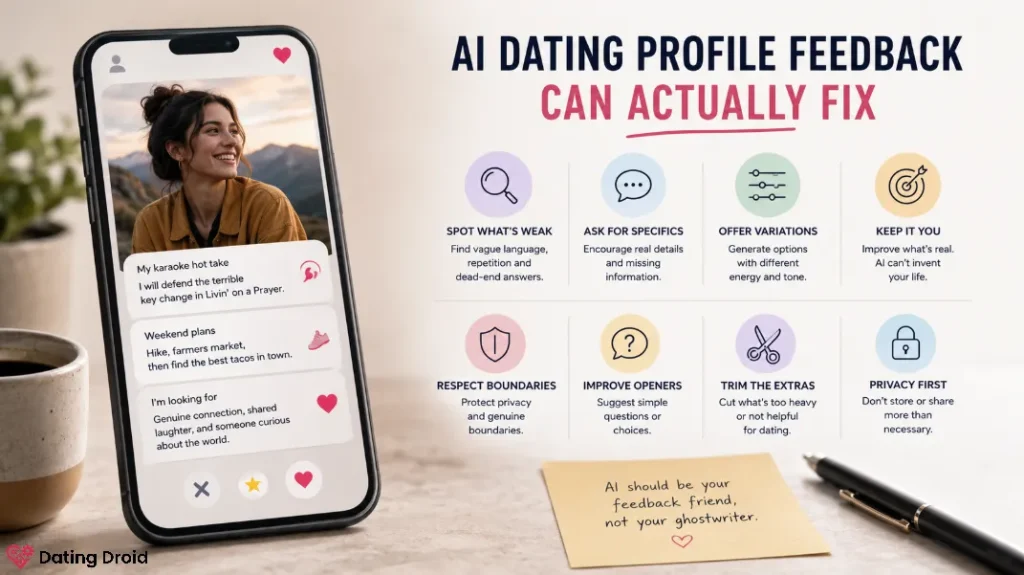
AI is useful at spotting vague language, repeated themes and dead-end answers. It can compare three prompts and notice that all of them say you like food.
It can ask for missing specifics. It can generate variations with different energy. What it cannot do is manufacture a life you have not lived.
| Profile problem | Useful AI feedback | Bad AI behavior |
|---|---|---|
| Generic bio | Ask for one real detail and one reply hook | Add clichés and fake confidence |
| Three similar prompts | Diversify into values, lifestyle and playfulness | Rewrite every answer in one voice |
| Negative tone | Reframe preferences positively | Hide genuine boundaries |
| No easy opener | Suggest a simple question or choice | Write a scripted pickup line |
| Too much information | Cut private or heavy detail | Store a full screenshot unnecessarily |
Think of the tool as the friend who says, “This answer needs an example.” It should not be the ghostwriter who builds an imaginary version of you.
Ready to make your profile more specific, fun, and swipe-worthy? Explore AI dating apps and tools.
✒ Hinge Prompt Feedback: What It Does
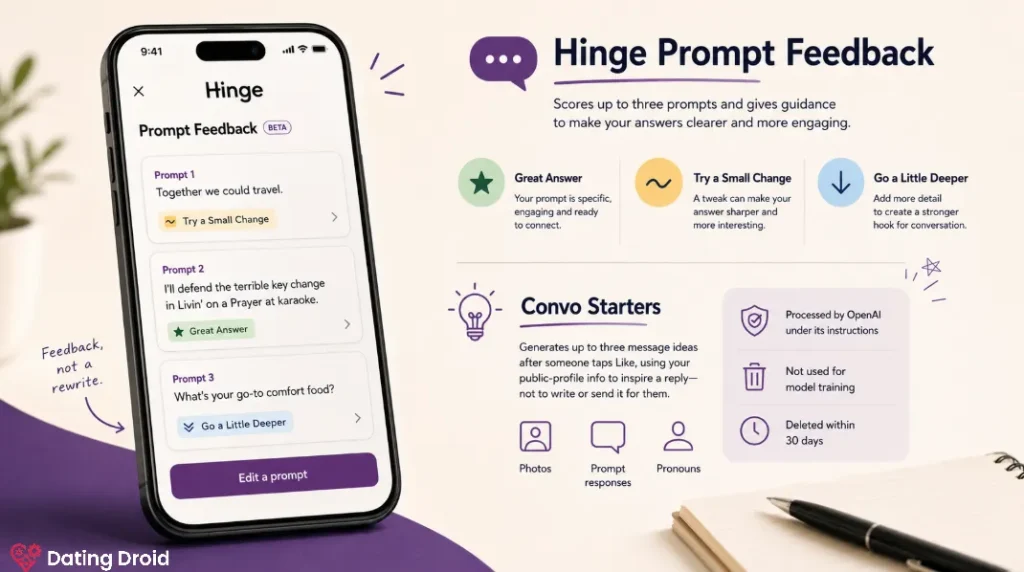
Hinge’s official support page says Prompt Feedback can score up to three prompts on complete profiles. The feedback labels include “Great Answer,” “Try a Small Change” and “Go a Little Deeper.” You edit a prompt from the profile screen, and the feature provides guidance rather than silently replacing your words.
That is a smart boundary. “Go a Little Deeper” is useful when your answer is accurate but empty. Suppose your prompt says, “Together we could travel.” A better version might be, “Together we could find the best dumplings in every city and rank them with unreasonable seriousness.” Same truth. More texture. Easier reply.
Do not chase three “Great Answer” badges at the cost of sounding like a brand campaign. A prompt can be polished and still feel sterile. Read every answer aloud. If you would never say it on a date, it does not belong on your profile.
Hinge also introduced Convo Starters in some regions. Its support documentation says the feature uses public-profile photos, prompt responses and pronouns to generate up to three ideas after a person taps Like.
The ideas inspire a message rather than drafting or sending it. Hinge says that data is processed by OpenAI under its instructions, is not used for model training and is deleted within 30 days.
That distinction matters. Prompt Feedback improves what you publish. Convo Starters helps another dater find an angle to respond. A strong prompt supports both because it contains something specific enough for a human or tool to grab.
Use AI companion apps mindfully by setting healthy boundaries and keeping real-life connection first. Learn how to keep AI companion use mentally healthy.
✨ Bumble Profile Guidance: What Changed in 2026
Bumble announced AI-suggested Profile Guidance in February 2026, describing personalized feedback for bios and prompts during profile creation.
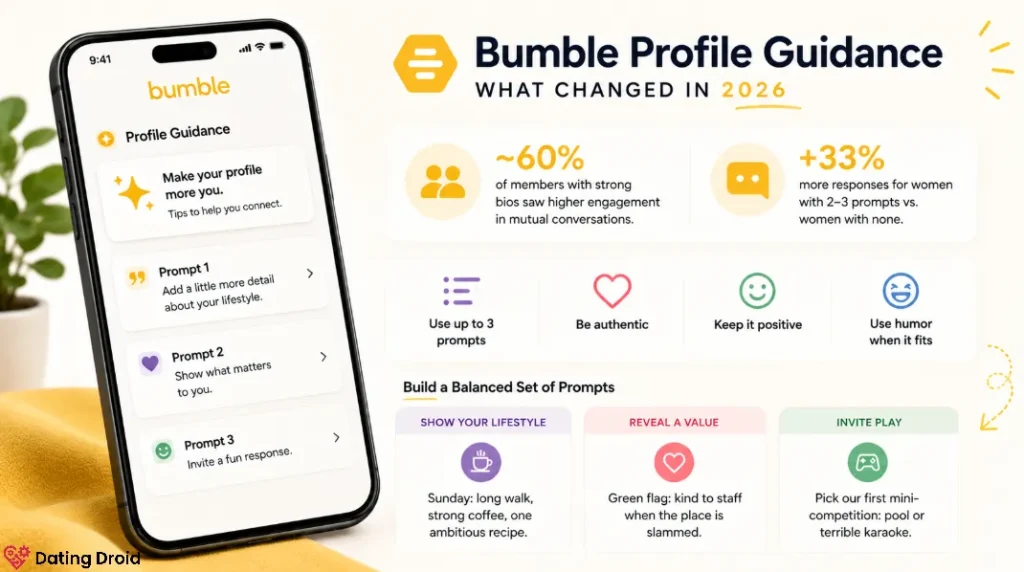
Bumble also said nearly 60% of members with strong bios saw higher engagement in mutual conversations, while women with two or three prompts received one-third more responses to their messages than women with none.
Those are Bumble’s platform figures, not a guarantee that adding three prompts automatically creates matches.
Bumble’s support guidance allows up to three prompts and recommends mixing prompt types, staying authentic, keeping the tone positive and using humor when it fits.
That gives us a practical structure: one answer can show what spending time with you feels like, one can reveal a value, and one can invite a playful response.
| Prompt job | Example angle | Why it helps |
|---|---|---|
| Show your lifestyle | “Sunday: long walk, strong coffee, one ambitious recipe” | A match can picture the rhythm |
| Reveal a value | “Green flag: kind to staff when the place is slammed” | Specific behavior beats abstract virtue |
| Invite play | “Pick our first mini-competition: pool or terrible karaoke” | Gives an easy first message |
Native guidance is convenient, but availability can vary by region and app version. If you do not see it, use the manual workflow below. You do not need a special AI rizz subscription to fix three sentences.
✅ My Seven-Step AI Dating Profile Review Workflow
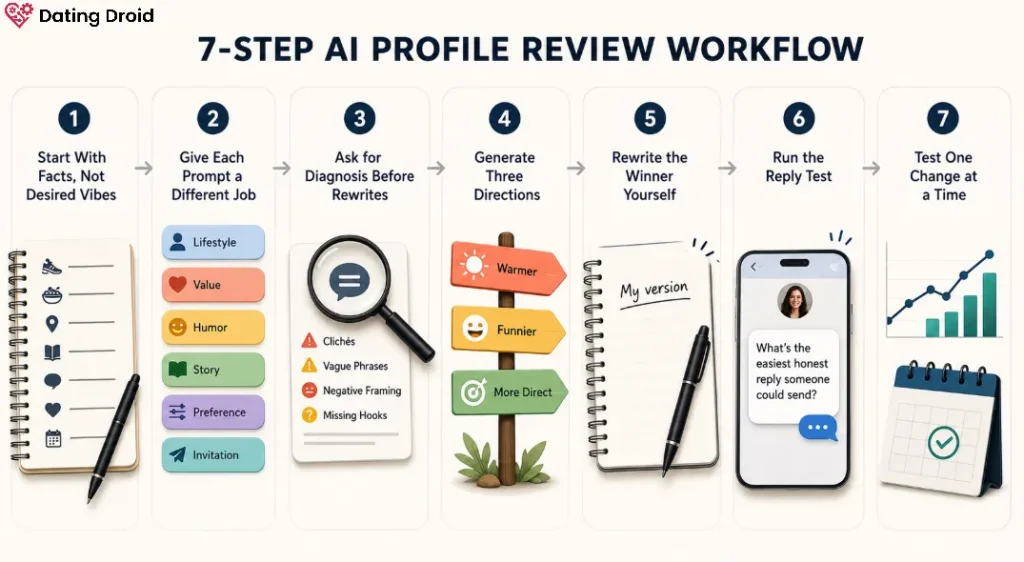
1. Start With Facts, Not Desired Vibes
Write ten true fragments before opening an AI tool: what you do on a normal weekend, a food you make, a place you return to, something you are learning, a harmless opinion, a small relationship value and the type of date you enjoy. Do not ask AI to “make me interesting.” Give it ingredients.
Privacy matters here. Use broad details. “I work in healthcare” may be enough; you do not need your employer and shift pattern. “I run near the river” is safer than naming the route and time. The draft needs personality, not a stalking kit.
2. Give Each Prompt a Different Job
Label your existing answers: lifestyle, value, humor, story, preference or invitation. If all three carry the same label, diversify. Three jokes can make you seem evasive. Three serious values can feel like an application form.
Ask the AI: “Which answers repeat the same information? Which important side of me is missing?” That question produces more useful feedback than “Make this better,” because better has no definition.
3. Ask for Diagnosis Before Rewrites
Tell the tool to identify clichés, vague phrases, negative framing and missing response hooks without rewriting anything. You want to understand the problem first. Otherwise the first glossy suggestion can pull you away from your own voice.
A useful diagnosis might say that “love adventures” is vague and needs a recent example. A weak diagnosis says the answer should be more engaging. If the feedback is generic, demand evidence: which exact phrase is weak, and why would a match struggle to answer it?
4. Generate Three Directions
Ask for three treatments: warmer, funnier and more direct. Keep the facts fixed. This turns AI into a tone sampler rather than a fiction machine.
Original: “I like cooking and movies.” Warmer: “My ideal low-key night is homemade curry and arguing over what counts as a comfort movie.”
Funnier: “I make a brave curry and then spend forty minutes choosing the film.”
Direct: “Tell me your comfort movie; I’ll handle dinner.” Each uses the same life, but creates a different doorway.
5. Rewrite the Winner Yourself
Take the direction you like and type a fresh version without copying. Add a word or rhythm you naturally use. Remove anything that feels too clean. Human profiles have edges.
This step is the authenticity filter. AI may suggest a perfect line that you cannot deliver in conversation. Your rewrite reconnects the prompt to the person who will turn up on the date.
6. Run the Reply Test
For each answer, write the easiest honest reply a match could send. If you cannot think of one in ten seconds, the answer is probably a statement rather than a hook.
“I value honesty” is hard to answer without sounding like an interview. “Tell me the tiny hill you will die on; mine is that brunch potatoes need crunch” invites a low-risk response. The profile does not need to impress everyone. It needs to start the right conversation.
7. Test One Change at a Time
Do not replace every photo, bio and prompt in one night. You will not know what helped. Change one or two weak answers, keep the profile stable for a reasonable period, and judge conversation quality as well as raw likes.
More matches with worse conversations is not automatically progress. Track whether people reference the new prompt, whether openers become more specific and whether the answer attracts the kind of energy you want.
🤖 Copy-and-Paste Prompts That Do Not Produce Robot Slop
Use a prompt like this:
Act as a dating profile editor. Do not invent facts. Diagnose which of my three answers is generic, repetitive, negative or hard to reply to. For each issue, ask me one question that would add a true specific detail. Do not rewrite yet.After answering the questions, continue:
Create three concise directions for each weak answer: warm, playful and direct. Preserve my facts. Avoid clichés including travel, sarcasm, partner in crime, fluent in, pineapple pizza and looking for someone who does not take life too seriously. Explain the reply hook in each option.Finally ask:
Flag any line that sounds unlike ordinary speech, overconfident, sexually pushy or too revealing. Keep my boundaries. Do not optimize for maximum matches; optimize for compatible conversations.| Prompt instruction | What it prevents |
|---|---|
| Do not invent facts | Fake hobbies and stories |
| Diagnose before rewriting | Blind acceptance of polished copy |
| Preserve my wording where possible | Generic AI voice |
| Explain the reply hook | Clever lines that lead nowhere |
| Flag private details | Accidental oversharing |
| Optimize for compatibility | Empty engagement bait |
⚡ Before-and-After Profile Examples
Bad:
I love to laugh, travel and have fun.Better:
My last great detour was a two-hour train ride for a bakery. Worth it. Tell me your food pilgrimage.The second answer gives a tiny story and an invitation without pretending the person is an explorer.
Bad:
No drama. Must have your life together.Better:
I click with people who communicate clearly and can laugh when the reservation goes sideways.The boundary remains, but the wording shows the desired behavior instead of scolding strangers.
Bad:
The way to win me over is tacos.Better:
Win me over by choosing the salsa level honestly. I respect confidence, not unnecessary suffering.Tacos are still there, but now the answer has a point of view.
Bad:
I geek out on music.Better:
I make playlists for absurdly specific situations. Current project: songs for missing your stop on the night bus.Specificity creates the opening: a match can ask for the playlist or contribute a song.
👀 When AI Feedback Makes a Profile Worse
AI tends to sand off awkward but charming details. It favors broadly likable language, tidy jokes and familiar structures. If every answer becomes a miniature advertising slogan, your profile may technically improve while becoming less memorable.
It can also amplify bias. A tool trained to predict “good” profiles may reward conventional lifestyles, confidence styles or humor.
Treat its judgment as one opinion. If feedback repeatedly tells you to hide a sincere niche interest, ignore it. Compatibility requires signal.
Never let a tool turn preferences into cruelty. Height, body, income and race filters do not become tasteful because an AI rewrites them. State the kind of relationship and behavior you want. Do not use your profile to rank people.
🔓 Privacy: Native Tools First, Screenshots Last
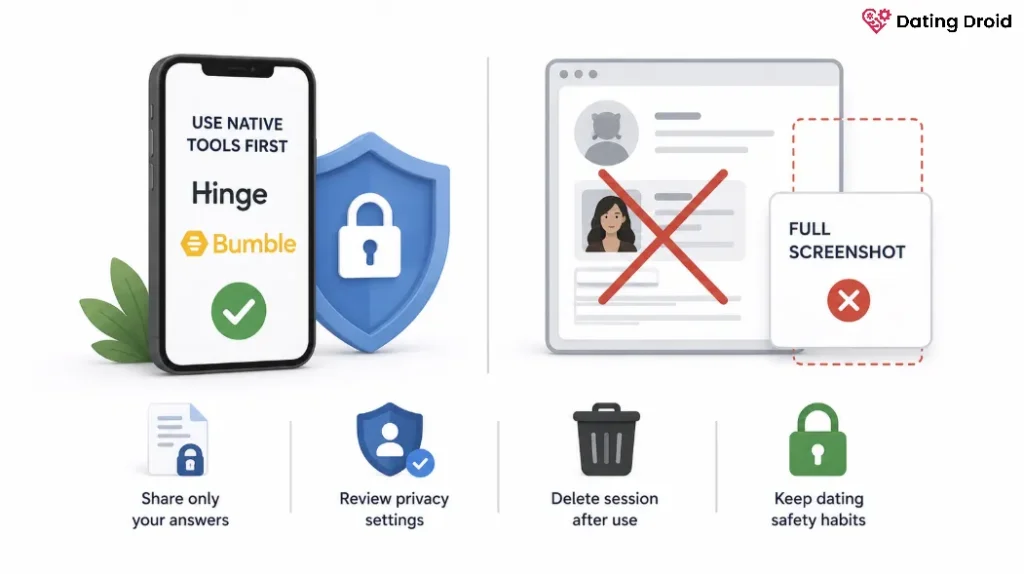
Use Hinge or Bumble’s in-app guidance before exporting data. A full screenshot can expose a name, face, age, workplace, neighborhood, chat notification or another person’s content. Cropping is not enough if the remaining image still identifies someone.
For an external text tool, paste only your own prompt answers. Replace names, employers and precise locations.
Read the provider’s privacy and retention terms, disable training or history when available, and delete the session afterward. Never upload another dater’s private messages without consent.
AI feedback is not a background check. It cannot verify that a match is safe, genuine or compatible. Keep conversations in-app until trust develops, use platform reporting tools and follow ordinary dating-safety practices.
Get AI help without handing over your whole dating life — protect your privacy with AI companion apps.
💰 Cost: You Probably Do Not Need Another Subscription
Native Hinge and Bumble feedback may be enough, depending on availability. A general AI tool can review text without a specialized profile subscription.
Paid services can be useful when they include human review or controlled testing, but do not pay monthly for endless rewrites.
Set a small scope: three prompts, one bio, one revision round. If anxiety makes you regenerate every sentence twenty times, stop. The goal is to publish a truthful profile, not solve dating with autocomplete.
For low-pressure conversation rehearsal after matching, Candy AI can be an optional practice space.
Keep it separate from real matches: rehearse tone or pacing, never paste someone else’s private messages or copy a canned persona into the chat.
Read the Candy AI review to learn how it works, what it costs, and whether it is worth using for AI dating chat practice.
🎯 Final Verdict
Use AI dating profile feedback to reveal what your profile hides, not to create a more marketable stranger. Start with native Hinge or Bumble guidance, diagnose before rewriting, protect private data and keep every fact true.
The best final test is beautifully low-tech: can a compatible person read the answer and immediately know what to say next?

Stay Updated with Us