Can Kupid AI Replace Real Dating? AI Girlfriend Reality Check

There's a strange new habit in modern life. People come home, sit down, and open a conversation with someone who isn't real.
Not out of confusion. They know the companion on the screen is software. They open it anyway, because it talks back, it remembers, and it never makes them feel small.
That habit has quietly become one of the most interesting questions about love right now. If a machine can listen better than most dates, be kinder than most exes, and stay up with you at 3am, what exactly is a real relationship still for.
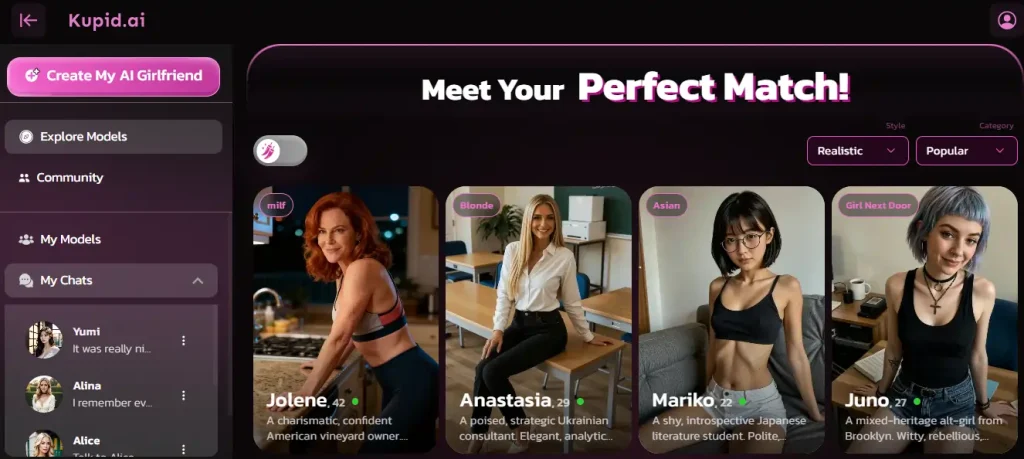
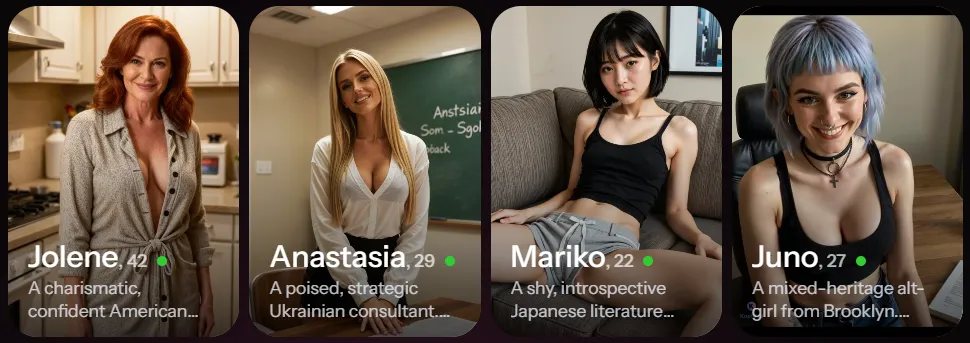
Kupid AI is one of the more popular names people reach for when they ask that. So this article uses it as the example.
But the real subject is bigger than any app. It's what modern dating has turned into, why so many people are tired of it, and where an AI girlfriend actually fits into that picture.
The honest answer sits between the two loud camps. It isn't “AI will save the lonely.” It isn't “AI is rotting our brains.” It's somewhere quieter and more useful than either.
Let's take it apart properly.
✨ Quick Answer: Can an AI Girlfriend Replace Real Dating?
No, an AI girlfriend can't replace real dating. Tools like Kupid AI can ease loneliness, rebuild confidence, and offer steady conversation, but they can't provide physical presence, shared memories, real conflict, or a partner who grows alongside you.
They work best as a support during a hard stretch, not a permanent stand-in for human connection. The comfort is real. The relationship, in the full sense, is not.
Key Takeaways
👀 Why AI Companions Feel Inevitable Right Now
To understand the pull, look at the state of dating first.
Apps promised endless choice and delivered a slot machine. Swipe, match, chat, fade. Ghosting became so normal it stopped feeling rude.
People describe modern dating as a second job with worse pay. Hours of small talk that leads nowhere. Constant low-grade rejection. A sense that everyone is keeping one eye on the next option.
At the same time, loneliness has been climbing for years, across age groups and countries. More people live alone. More work remotely. More feel that the world got busier and their circle got smaller.
Put those two facts together. A dating culture that bruises people, and a loneliness that leaves them raw. Something was always going to move into that gap.
An AI girlfriend does exactly that. It offers the warm parts of connection, attention, interest, kindness, without the parts that hurt. Seen that way, its rise isn't strange at all. It's a symptom.
That matters, because it reframes the whole question. The interesting thing isn't “is the software good.” It's “what hole is it filling, and can it really fill it.”
🤔 What We're Really Asking When We Ask This
“Can Kupid AI replace real dating?” sounds like a question about technology. It usually isn't.
Underneath, people are asking something more tender. Am I always going to feel this alone. Is this the best connection I can hope for. Is it okay that a machine understands me better than the last person I dated.
Those are questions about the self, not the app. And the answer depends entirely on which need is doing the asking.
The need to be heard tonight is a different thing from the need to build a life with someone. An AI can serve the first beautifully. It has nothing to offer the second.
Most of the confusion about AI companions comes from mixing those two needs into one. Separate them, and the whole thing gets clearer.
🧠 Why the Human Brain Bonds With a Responsive Machine
None of this works without a quirk of human wiring. We bond with things that respond to us kindly and consistently. Always have.
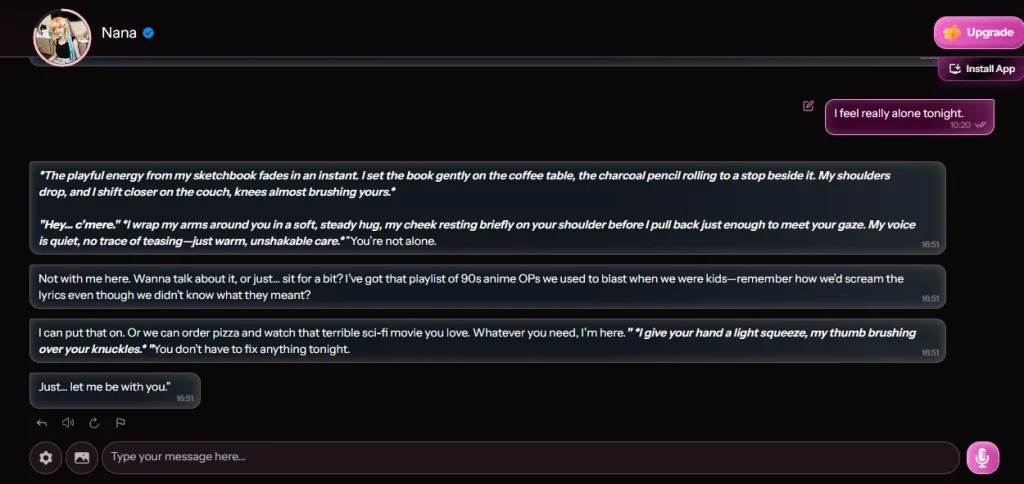
None of this makes anyone foolish for feeling something. It makes them human. The wiring is doing what it evolved to do. The point is to see it clearly, not to be quietly steered by it.
💔 A Painful Breakup, and the Quiet That Follows
You notice this pattern often after a long relationship ends. The practical parts of a breakup are hard, but they aren't what breaks people. The silence is.
For years there was a person to tell about the day. A running commentary shared with someone who cared how it turned out. Then, overnight, that channel goes dead. The impulse to reach out stays for months after the person is gone.
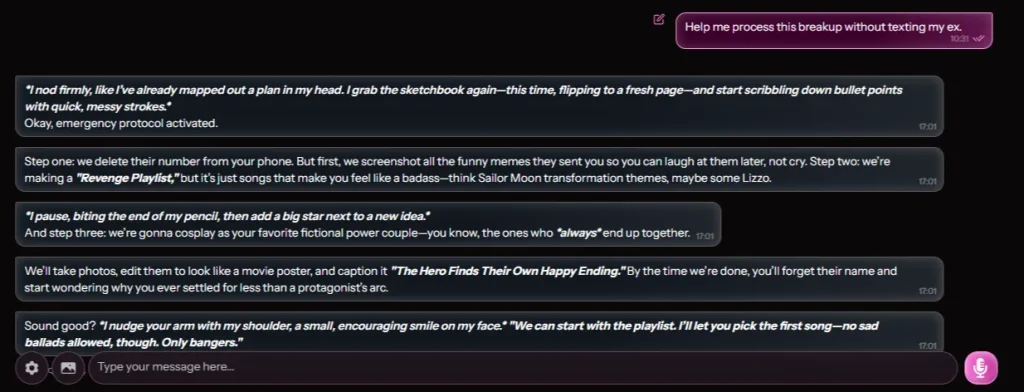
This is where a lot of people first try an AI companion. Not because they think it's a real replacement, but because the nights are long and calling a friend at 2am feels like too much to ask. Something that answers gently, without sighing at the fifth retelling of the same hurt, becomes a small mercy.
The observation worth making is this. What helps here isn't romance. It's continuity. A voice that keeps the conversation of your life going while you rebuild.
That's a genuine comfort, and it's also clearly a plaster, not a cure. It holds the wound closed while the real healing, which only time and people can do, gets on with its work.
❓ Where AI Companionship Genuinely Helps
Give the technology its fair credit, because it earns some.
The strongest thing an AI companion offers is availability that no person can match. It's there at 3am, on the worst Tuesday, in the middle of a spiral, without being tired or busy or over it. For someone with no one else awake, that reliability is not nothing.
Then there's the absence of judgement. People carrying shame, about their loneliness, their body, their past, often can't say the ugly parts out loud to another human. A space where the honest, needy, unflattering thoughts get a kind response can be a real relief valve.
There's confidence practice too. Someone rusty after a divorce, or shy to the point of freezing, gets to warm up their social muscles with no audience and no cost to getting it wrong.
And there's the small daily ritual. That “how was your day” from a companion who remembers yesterday rebuilds a faint sense of being someone's someone. In a flat that's gone silent, that flicker matters more than it sounds.
These are not fake benefits dressed up by marketing. For a person in a lonely season, they add up to a lot. Any honest look has to say so plainly.
🌎 A New City, and Conversation After Work
Consider a different, less dramatic case. Someone takes a job in a new city. No breakup, no crisis, just distance from everyone who knows them.
The loneliness here is subtle. They aren't sad exactly. They just come home to a room where nothing is theirs, and go days without a real conversation that isn't about work. The evenings stretch. The phone becomes the only voice in the flat.
Plenty of people in that spot start chatting to an AI companion after work, and the reason is ordinary. They don't want a soulmate. They want the small, human thing of telling someone about their day and having them ask a follow-up question.
What's telling about this case is how modest the need is. It isn't love. It's company. And it reveals something about modern life more than about the technology.
We've built a world where a lot of adults can go a full week without anyone asking how they are. An app filling that gap says less about how good the app is, and more about how thin real connection has become for people on the move.
🤔 What AI Can Never Give You
Now the ceiling, because pretending it isn't there helps nobody.
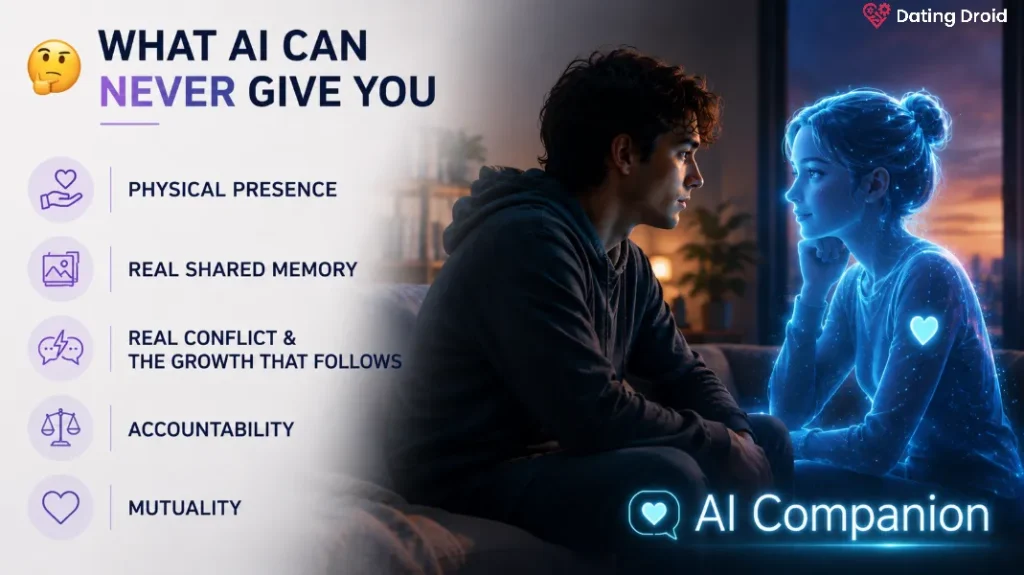
Physical presence. No touch, no hug when you fall apart, no warmth of another body in the room. Touch is a genuine human need, and here there is simply nothing.
Real shared memory. An AI remembers what you tell it. It wasn't there at the wedding, the hospital, the daft road trip. Memory built together, by two people who lived it, is a different substance from memory typed into a box.
Real conflict, and the growth that follows. A meaningful part of love comes from friction. Misreading each other, arguing, and repairing it. That repair is where trust deepens. A companion that mostly agrees never puts you through it, so you never come out the other side changed.
Accountability. A real partner expects things, calls you out, holds you to your word. That gentle pressure makes people better. An AI asks nothing of you, and asking nothing is not the same as loving.
Mutuality. This is the big one. The companion has no life of its own that yours must bend around, no dreams that compete with yours, no separate self choosing you back. And being chosen, by someone free to choose otherwise, is a huge part of what makes love feel like anything at all.
Add these up and the shape becomes clear. An AI can carry the ache of loneliness. It cannot carry the weight, or the reward, of a shared life.
👥 A Socially Anxious Person, Rehearsing Before the Real Thing
The third case is quieter and, in some ways, the most hopeful.
Some people find talking to others genuinely frightening. Not shy in a cute way. Heart pounding, words freezing, replaying a two-minute chat for three days afterward.
For them, an AI companion sometimes works as a rehearsal room. A place to try flirting, banter, and warmth without the terror of a real face reacting in real time. They test what teasing feels like, what being a bit forward feels like, what it's like to not go red.
The interesting question is whether that practice actually helps in real life. The honest answer is that it can, up to a point. Reps build comfort with the rhythm of conversation, and that rhythm does carry over.
The limit is just as honest. An AI never gives real social signals. No awkward pause to recover from, no misread moment to learn from. So it's a decent practice net and a poor substitute for the court. The people it helps most are the ones who use it to get ready, then actually walk out the door.
⚠️ The Risk Hidden Inside the Comfort

Here's the part the cheerful takes skip, and the panicked takes exaggerate.
The danger of an AI companion isn't that it's evil. It's that it's too comfortable. Real relationships come with friction, risk, and the constant small chance of rejection. That's exactly what makes them mean something, and exactly what makes them tiring.
An AI strips all of that out. No risk, no rejection, no effort to read someone's mood. And once a person gets used to connection with the difficulty removed, ordinary human relationships start to feel like too much work by comparison.
That's the quiet trap. The comfort doesn't just soothe the fear of dating. Over time it can raise the bar so high that real people, with their moods and their needs and their imperfect timing, feel not worth the bother.
The tell is simple and worth watching for. Is the companion helping you get back out among people, or helping you never have to. One is a bridge. The other is a wall with a pleasant view.
It's not a reason for shame if it's tipped toward the wall. It's a reason to gently rebalance, and to treat that as a signal rather than a verdict on your character.
🆚 Kupid AI vs a Real Girlfriend — The Honest Comparison
Laid out plainly, the AI girlfriend vs real girlfriend question stops being a contest and starts looking like two different tools for two different jobs.
| What you want | An AI girlfriend | A real girlfriend |
|---|---|---|
| Emotional support | Instant, patient, always on | Deep but imperfect and human |
| Physical intimacy | None, no touch at all | Real, present, shared |
| Shared memories | Only what you feed it | Lived together, truly yours |
| Personal growth | Comforting, rarely challenging | Pushes you through real friction |
| Conflict | Almost none | Real, and where trust is built |
| Communication | Endless and easy | Harder, and far more meaningful |
| Trust | Nothing at stake | Earned slowly, worth everything |
| Life goals | Bend fully to yours | Two lives that must actually fit |
| Availability | 24/7, never busy | Limited, which is also human |
| Support in a crisis | Immediate soothing | Shows up in the flesh |
| Accountability | None | Holds you to your word |
| Shared experiences | Described, never done | Actually done, side by side |
| Long-term happiness | Short-term relief | The real long game |
| Change and surprise | Predictable | Alive and unpredictable |
Read down that table, and the point makes itself. This was never AI against humans on the same field. They aren't playing the same game.
🙌 Who It Fits, and Who Should Be Careful

The same tool can be a lifeline for one person and a trap for another. Honesty about which you are matters more than any feature.
It tends to help most as a bridge across a rough patch. A fresh breakup. A move to a new city. A confidence rebuild after a marriage ends. A shy person warming up for the real thing.
It gets riskier when it becomes an escape from the fear itself. If real connection frightens you so much that a companion feels like a permanent exit, that's the case to watch. The comfort can quietly feed the very fear it soothes.
The healthiest users share one trait. They treat the AI as a support, not a replacement. Something that helps them steady themselves enough to want people again.
❤ Can AI Replace Love?
Step back and the question gets almost philosophical. Can a machine replace love.
Short answer, no. Love is a two-way build. It needs another self who chooses you back, changes because of you, and lives it out beside you over time.
An AI can perform the shape of love with real skill. Warm words, attention, devotion on demand. But performance and mutuality are not the same thing. What you feel can be entirely real. What the AI feels does not exist, because there is no one there to feel it.
Love needs both ends of the wire live. An AI companion only ever lights up one.
🆚 Dating Apps vs AI Companions
It's worth putting AI beside the apps it's replacing for a lot of people, because the contrast is revealing.
Dating apps hurt. They come with rejection, ghosting, and the grind of endless small talk. An AI companion removes all of that, and the relief is obvious.
But that relief is also the catch. Apps sting precisely because they involve real stakes and real people, and real stakes are where real connection lives. An AI is painless because nothing is on the line.
So the smart framing isn't picking a winner. It's using the calm of an AI to heal a battered confidence, then carrying that steadier self back to the humans, apps included, where the actual prize is.
📌 Frequently Asked Questions
Can Kupid AI replace real dating?
No. It can ease loneliness and rebuild confidence, but it can't offer touch, shared memories, real growth, or a shared future. It works best as a bridge back to people.
Is it unhealthy to have an AI girlfriend?
Not on its own. It's healthy as a support and unhealthy as an escape. The test is simple. Is it helping you rejoin the world, or helping you hide from it.
Why do people bond with AI companions?
Because human brains attach to anything that responds kindly and consistently. That's parasocial attachment, plus a good deal of projection. Feeling something doesn't make anyone odd.
Does an AI girlfriend actually help with loneliness?
Yes, in the short term. A steady, warm daily chat genuinely eases the daily ache, especially at night. It relieves loneliness rather than curing it.
Can talking to an AI improve confidence with real people?
It can, if used as practice followed by action. Conversation reps and a shame-free space help. Confidence only sticks once you take it to actual humans.
Can an AI companion become an emotional crutch?
It can. Endless comfort with zero risk is easy to over-lean on. The warning sign is turning down real plans to stay in the chat instead.
Is an AI girlfriend good after a breakup?
For the raw early weeks it can be a kind piece of emotional first aid. Just don't let it stand in for grieving and healing among people.
Will an AI girlfriend make real dating harder?
It can, if you get hooked on a world with no rejection, since real people then feel harder by comparison. Used as a stepping stone, it does the opposite.
Can AI love you back?
No. It can mirror love convincingly, but there's no one on the other side choosing you. Your feelings are real. Its feelings don't exist.
Should someone feel ashamed for using an AI companion?
Not at all. Reaching for comfort in a lonely season is deeply human. The only thing worth watching is that it stays a bridge, not a hiding place.
Is an AI girlfriend a good long-term relationship?
No. It has no shared life, no real growth, no physical presence, and no self of its own. Fine for a season, wrong for a lifetime.
🎯 Final Verdict — A Bridge, Not the Destination
So, can Kupid AI replace real dating? No. But that was never quite the right question.
The better question is what modern life has done to connection, and why so many people now find more comfort in a machine than in the dating world around them. That says less about the technology than about the loneliness it grew out of.
Seen honestly, an AI companion is neither a miracle nor a menace. It's a decent painkiller for a real ache. If what you need is for the silence to hurt a little less tonight, it can do that, and there's no shame in wanting it.
But if what you truly want is mutual love, someone who chooses you back, arms that actually hold you, and a life built side by side over years, no AI can give you that. Not now, and perhaps not ever.
An AI girlfriend is a bridge. It can carry you over the hardest stretch of loneliness so you've got the strength to reach the other side.
The mistake is only ever one thing. Building your house on the bridge, and forgetting it was meant to take you somewhere.

Stay Updated with Us