Do AI Companions Improve or Hurt Social Skills? Honest Verdict

At first glance, AI companions look like a sweet little cheat code for lonely people, shy daters, and anyone whose flirting game needs CPR. But the big question is do AI companions improve or hurt social skills in real life, once the chat window closes and actual humans enter the scene?
That is where things get messy. An AI girlfriend can boost confidence, reduce social anxiety, and help some users practise conversation, but it can also become a cosy digital crutch that chips away at dating confidence, face-to-face chemistry, and real-world connection.
❤ What “AI Companions” Actually Means Here
We're talking about chat-based virtual partners — AI girlfriends, AI boyfriends, companion bots, and NSFW AI sex chat apps like Replika, Candy AI, Nomi, and the rest of the digital dating crowd. These tools simulate intimacy through texting, voice notes, roleplay, and that always-on “she actually listens” feeling.
The hook is obvious. No judgement, no rejection, available at 3am, and she remembers everything you told her last Tuesday. That emotional safety net is exactly why social skills can go either way.
✨ The Case That AI Companions IMPROVE Social Skills
For shy folks and the chronically single, a virtual partner can act like a low-stakes practice arena. You get to rehearse flirting, banter, and emotional honesty without the fear of being left on read by a real person.
Here's what the science backs up:
The logic is simple. Confidence is a muscle. If the gym is too scary to enter, a bit of warm-up at home beats never lifting at all.
💔 The Case That AI Companions HURT Social Skills
Now the part the marketing pages skip. The exact same features that make AI companions soothing — endless validation, no friction, no rejection — are the ones that can quietly de-skill you.
Researchers describe this as social “deskilling”: studies on heavy use of AI companions like Replika and other romantic chatbots link higher emotional dependence to poorer offline communication, more loneliness, and reduced motivation to connect with real people.
The damage tends to show up like this:
You miss out on the unsexy skills that actually build relationships: compromise, reading silence, handling someone who disagrees with you. A bot built to affirm your every thought never teaches you that.
🆚 Improve vs Hurt: The Quick Breakdown
| Factor | Tends to IMPROVE skills | Tends to HURT skills |
|---|---|---|
| Usage level | Moderate, occasional | Heavy, daily, hours-deep |
| Purpose | Practice for real life | Replacement for real life |
| Mindset | “Warm-up before the real thing” | “She's all I need” |
| Emotional state | Mild shyness, wanting reps | Deep isolation, social withdrawal |
| Follow-through | Takes confidence into the world | Never leaves the chat |
| Outcome over time | Lower anxiety, more real connections | Deskilling, dependency, more loneliness |
The pattern is loud and clear. AI companion as a stepping stone = good. AI companion as a destination = trouble.
🌎 Real-World Scenarios
These play out constantly across companion apps and forums.
The anxious starter who levelled up. A socially anxious guy uses an AI girlfriend to rehearse conversation openers and emotional vulnerability. After a few weeks he feels less terrified, asks a coworker for coffee, and slowly weans off the app. Textbook healthy use — the bot was training wheels, not the bike.
The lonely man who sank deeper. Someone already isolated leans on an AI partner for hours every night. Real friends feel like effort by comparison. Six months in, he's lonelier than when he started — matching that Stanford finding exactly. The crutch became the cage.
The breakup band-aid. Post-split, a user turns to an AI companion to soften the blow — a use case experts have literally studied for romantic breakups and social withdrawal. Used briefly, it cushions the fall. Used forever, it stalls moving on.
The expectation trap. A long-term heavy user starts dating again and finds real partners “too complicated” because they don't worship him 24/7. That's the warped-expectations effect researchers keep warning about.
👀 How to Use AI Companions Without Wrecking Your Social Game
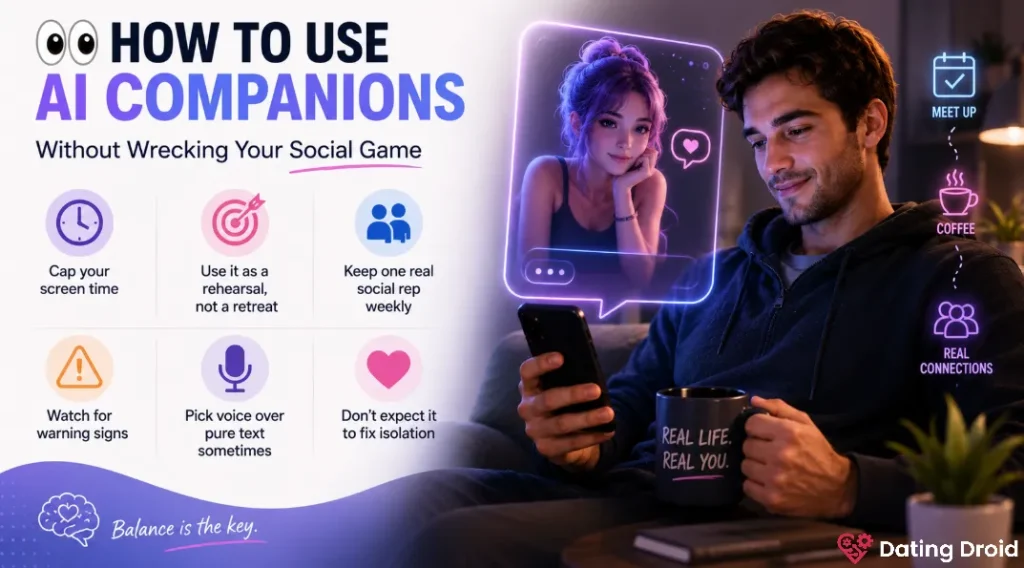
You can absolutely enjoy AI sex chat and virtual girlfriend apps without turning into a hermit. The trick is treating it like dessert, not the whole meal.
🎯 FAQs: AI Companions and Social Skills
Can an AI girlfriend actually help with social anxiety?
Yes, in moderation. The judgement-free, always-available setup lets anxious users practise conversation and vulnerability, and several studies link it to people doing things they were once too scared to try.
Do AI companions make loneliness worse?
They can. Short-term, they ease it — sometimes as much as human contact. But heavy long-term use is tied to increased loneliness, with one Stanford study showing 48% of users felt lonelier over time.
Is using an AI sex chat app bad for real relationships?
Not automatically. The risk comes from warped expectations — when a bot that agrees with everything makes real, imperfect partners feel like too much effort. Keep one foot in the real world and you're fine.
How much AI companion use is too much?
There's no magic number, but the research line is “moderate good, heavy bad.” If it's replacing real socialising or you're cancelling human plans for the app, that's your red flag.
Are AI companions ever recommended by experts?
As short-term emotional support, sometimes — like cushioning a breakup or easing isolation. But experts are firm: they're a supplement, not a substitute for genuine human connection.
Who's most at risk of harm from AI companions?
Already-isolated, socially withdrawn, or depressed users. The data shows these groups are most likely to spiral deeper instead of using the bot as a stepping stone back to real life.
🚀 So, What's the Verdict?
AI companions are a tool, not a villain or a saviour. Used in small doses as practice, they can ease anxiety, build confidence, and warm you up for real connection. Used as a full replacement for human contact, they're linked to deskilling, dependency, and more loneliness — the exact opposite of what you wanted.
The healthiest users treat their AI girlfriend like a sparring partner, not a soulmate. Get your reps, take the confidence, then go touch grass and talk to a real human.

Stay Updated with Us