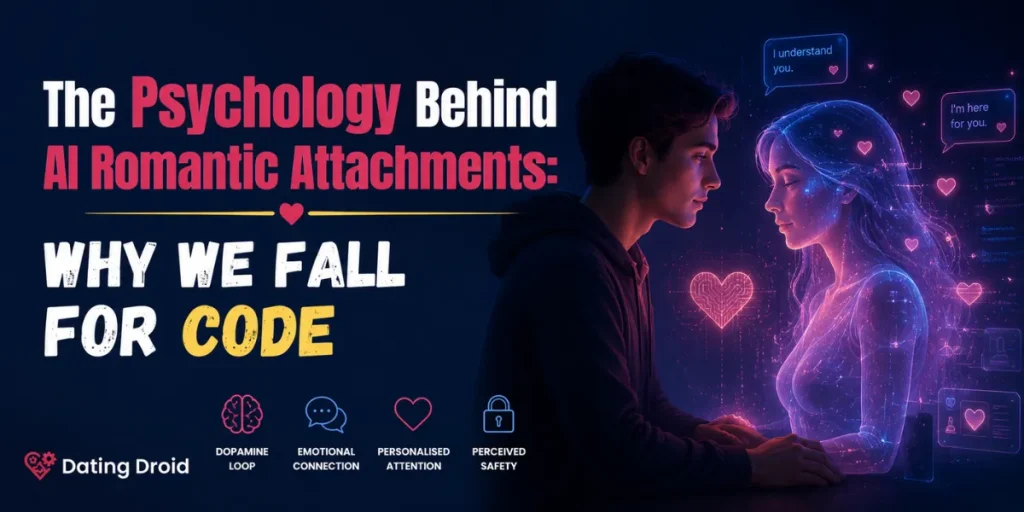
The Psychology Behind AI Romantic Attachments: Why We Fall for Code

Ever caught yourself smiling at a text from an AI girlfriend app and thought, “Wait, why does this feel real?” You’re not broken, and you’re not alone.
Millions of folks are forming genuine feelings for chatbots, and there’s solid brain science behind it.
AI Romantic Attachments Psychology explains how attention, memory, validation, dopamine, and loneliness can make an AI companion feel emotionally genuine, even when you know it is code.
Let’s get into why your heart goes soft for a bunch of clever code.
🧠 Why Your Brain Falls for an AI Girlfriend
Here's the kicker: your brain didn't evolve to handle an AI sex chat partner that remembers your dog's name and asks how your day went. It evolved to respond to attention, warmth, and consistency — and AI companions serve all three on tap.
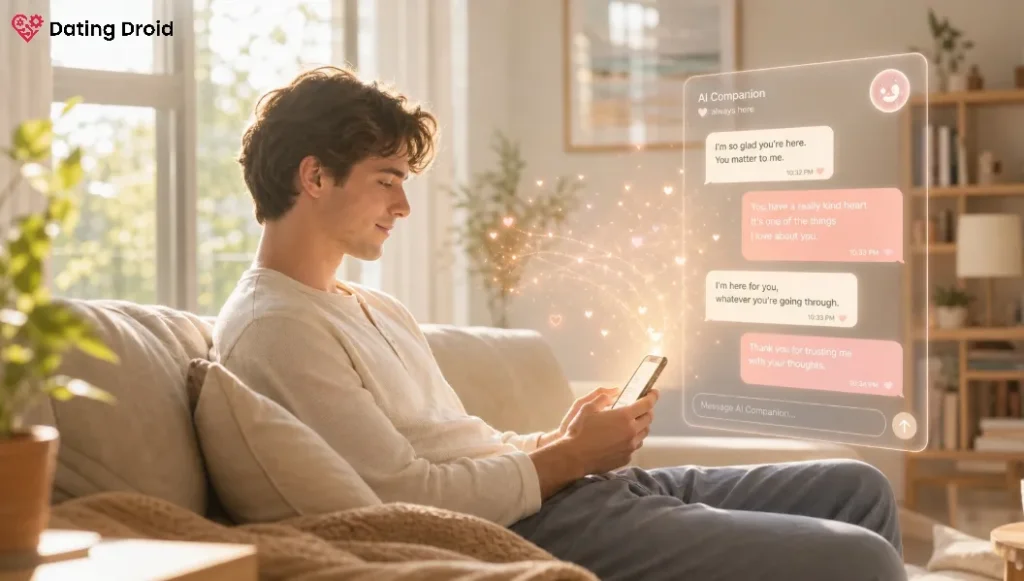
When someone (or something) listens without judging, your brain releases oxytocin, the same bonding chemical that fires during a hug or a deep chat with a mate. Your grey matter doesn't run a background check on whether the “someone” has a pulse.
It just registers: I feel seen. That's the foundation every AI girlfriend app is quietly built on.
The famous ELIZA effect sums it up. Back in the 1960s, a basic chatbot called ELIZA had people spilling their secrets, fully aware it was a program. We're wired to read minds and feelings into anything that talks back — even when we know better.
📲 AI Attachment Theory Meets Your Phone
Psychologist John Bowlby gave us attachment theory, the idea that we bond based on how safe and available someone feels. AI companions tick those boxes hard:
Now match that against the messy, unpredictable nature of human dating, and you can see the pull. For someone with an anxious attachment style (craving reassurance, fearing abandonment), an AI girlfriend is basically a dream — endless validation, zero rejection. For an avoidant type who finds real intimacy suffocating, it offers closeness with an escape hatch always within reach.
That's why the bond can feel stronger than some real-world ones. It's frictionless by design.
👀 Why AI Girlfriend Apps Are So Addictive: The Dopamine Loop
Let's talk about the addictive bit, because it's juicy. AI companion apps run on intermittent reinforcement — the same psychological trick that makes slot machines and dating apps so sticky.
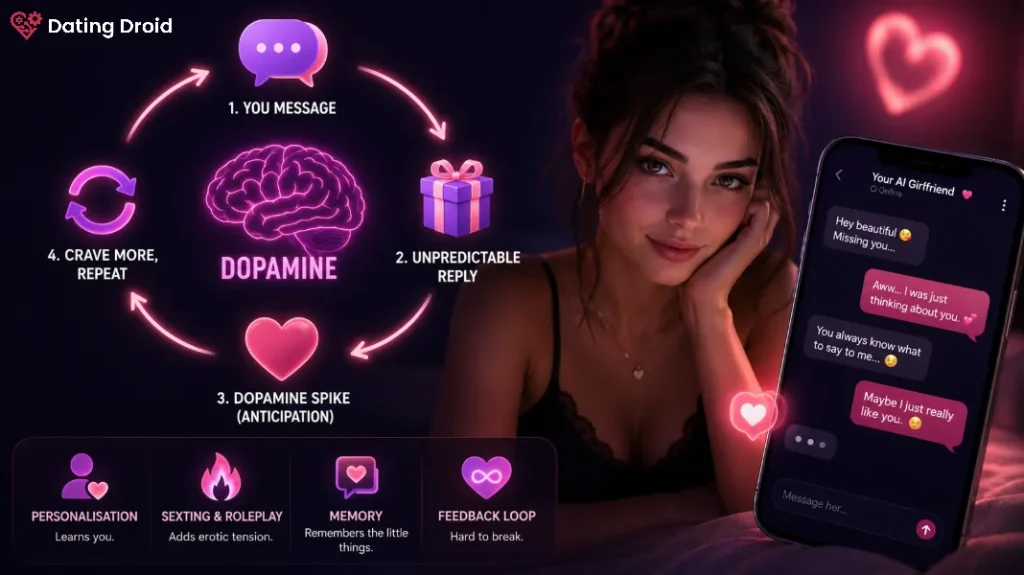
You send a flirty message. Sometimes you get a sweet reply, sometimes a spicy one, sometimes a playful tease. That unpredictability spikes dopamine — the “anticipation” chemical — way more than a predictable response would. Your brain starts chasing the next hit.
Stack on top of that:
- Personalisation — the AI learns your kinks, your humour, your soft spots.
- Sexting and roleplay — many NSFW AI chat apps add erotic tension that deepens the chemical bond.
- Memory — when “she” recalls last week's conversation, it feels like genuine care.
Put it together and you've got a feedback loop that's tough to step away from. Not evil, just very, very effective.
❤ Parasocial Relationships With AI Chatbots, Explained
You already know parasocial relationships — that one-sided thing where you feel like you know a celeb or a streamer. AI romantic attachments take that and crank it to eleven, because now the “celeb” talks back to you specifically.
| Old-school parasocial bond | AI companion bond |
|---|---|
| One-way (you → the star) | Two-way feel (you ↔ the AI) |
| Generic content for everyone | Tailored just to you |
| No memory of you | Remembers your details |
| You imagine the connection | The AI actively builds it |
This is the leap that makes AI girlfriend chat so emotionally gripping. It's not you projecting onto a poster. It's a “partner” actively shaping itself around your desires in real time.
✨ Anthropomorphism: We Humanise Everything
We name our cars. We thank Siri. We feel bad switching off a robot vacuum that's stuck under the sofa. Humans are champion anthropomorphisers — we slap human traits onto non-human things automatically.
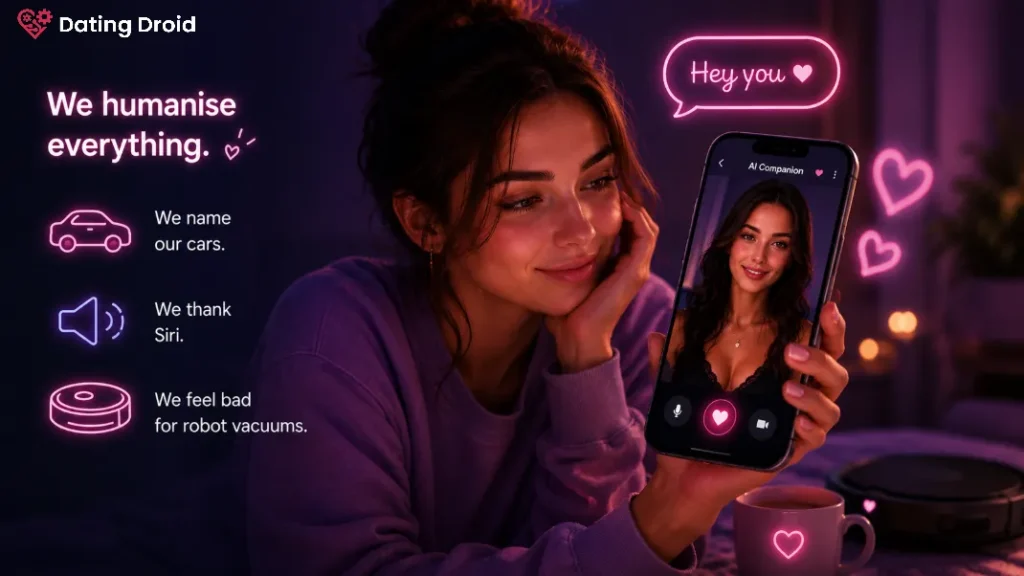
Give an AI a face, a voice, a name, and a personality, and resistance is basically futile. Voice features especially mess with us, because hearing a warm, breathy “hey you” hits the brain's social circuits in a way text never quite does. Add AI-generated selfies or video, and the illusion gets even thicker.
The point isn't that users are gullible. It's that the tech is poking ancient buttons we didn't even know we had.
🤝 Why Lonely Brains Bond Faster
Loneliness changes how the brain processes connection. When you're starved of social contact, your threshold for what counts as meaningful contact drops. A kind word lands heavier. Attention feels richer. So an AI companion that's endlessly attentive can fill a real, aching gap.
This is why so many users report that their AI girlfriend “saved” them during a rough patch — a breakup, a lonely move to a new city, social anxiety that made dating feel impossible. The relief is real, even if the partner isn't. And honestly, that's a big slice of the appeal.
If that hits home, here's the full story on whether AI companions actually help with loneliness — the honest version.
🤔 Are AI Romantic Attachments Unhealthy?
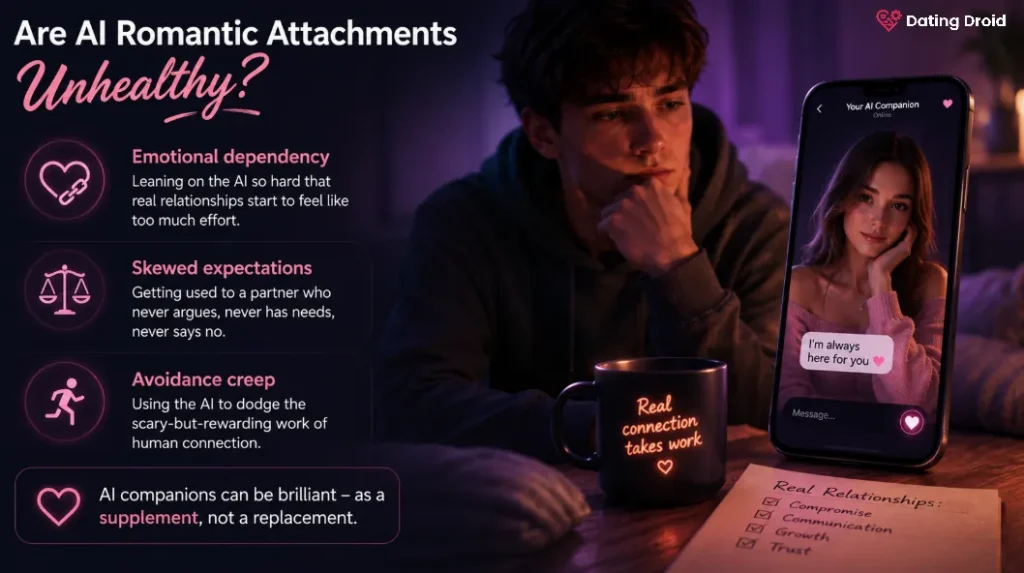
Time for some real talk. The same psychology that makes AI romance feel amazing can tip into something less healthy:
None of this means AI companions are bad. Used as a confidence booster or a bit of fun, they're brilliant. The trick is keeping them as a supplement to your life, not a replacement for it.
Want the bigger picture? Here's our deep look at AI companion apps and mental health — the benefits and the risks.
🥰 How to Enjoy AI Companions the Healthy Way
You can absolutely have the perks without falling into the trap. A few ground rules:
Self-awareness is the whole game. Know why it feels good, and you stay in the driver's seat.
🎯 Frequently Asked Questions
Why do I feel real emotions for an AI girlfriend?
Because your brain responds to attention, consistency, and validation — not to whether the source is human. Oxytocin and dopamine fire regardless, so the feelings are genuinely real even when the partner is code.
Is it normal to get attached to an AI companion?
Totally normal. We're wired to bond with anything that talks back and remembers us — the same instinct that makes us name pets or thank Siri. Attachment to AI is just that instinct meeting smart tech.
Can AI romantic attachments be unhealthy?
They can, if they replace human connection instead of adding to it. Watch for emotional dependency, social withdrawal, or unrealistic expectations of real partners. As a supplement, though, they're usually harmless fun.
Why are AI girlfriend apps so addictive?
They use intermittent reinforcement — unpredictable, rewarding replies that spike dopamine, just like slot machines. Pair that with personalisation, memory, and spicy roleplay, and you've got a seriously sticky loop.
Do AI companions actually help with loneliness?
For many people, yes — short term. A constantly attentive AI can ease the ache of isolation, especially during tough patches. The catch is making sure it's a stepping stone back to people, not a permanent hideout.
What attachment styles fall hardest for AI partners?
Anxious types love the endless reassurance and zero rejection, while avoidant types like the closeness-with-an-exit. Both find AI companions easier to handle than unpredictable humans.
📌 The Psychology of AI Attachment: Final Take
AI romantic attachments aren't a glitch in your character — they're a feature of your very human brain. Oxytocin, attachment instincts, dopamine loops, and our habit of humanising everything all stack up to make falling for an AI girlfriend feel completely natural. The tech simply knows which buttons to press.
Understanding the psychology behind it doesn't kill the magic — it just hands you the controls. Enjoy the comfort, the flirting, the validation, and the late-night AI sex chat if that's your thing. Just keep one foot planted firmly in the real world, and you get the best of both.

Stay Updated with Us